


From Churches to "Belarusian Maldives": A Journey Through Belarus Across Time and Colors
Belarus can be discovered endlessly. Sometimes, it's enough to turn off the main highway to enter a completely different world: medieval fortress churches here neighbor the birthplace of rock legends, while industrial quarries transform into extraterrestrial lakes. Budzma.org offers a route through the Hrodna region that connects history, music, and nature.

Church of St. Casimir in Lipnishki. Photo: bel.wikipedia.org
Heritage of Lipnishki
We suggest starting the journey from Lipnishki — a town in the Hrodna region, on the Alita river. The name most likely comes from the surname of its former owners. This town greets travelers with the neo-Gothic Church of St. Casimir, whose spires reach skyward.
The parish church was founded here in 1510. Initially, it was a wooden church that stood on the eastern side of the town's market square.

The church in the early XX century. Photo: bel.wikipedia.org
The current brick neo-Gothic church was built around 1910. In the early XX century, the church grounds were enclosed by a rubble stone fence, with the main entrance marked by a gate.
During the Soviet era, the Church of St. Casimir operated continuously, but in 1951, authorities confiscated the rectory building. In the 1970s, the church was designated as an architectural monument.

Interior of the church. Photo: bel.wikipedia.org
A humble sacred historical monument, a small chapel, is also located in the local cemetery. The shrine looks like a typical 19th-century structure — a rectangular log cabin with a three-sided altar section.

Wooden chapel in the cemetery in Lipnishki. Photo: bel.wikipedia.org
In Lipnishki, remnants of the 19th-century estate of the Wolski family, the founders of the local church, have been preserved. The building is abandoned but partially conserved, and it looks beautiful. It stands out with an interesting three-level tower, whose upper tier is adorned with arched windows. On the rear side of the building, a chimney pipe and a small extension with neo-Gothic decorative elements have been preserved.
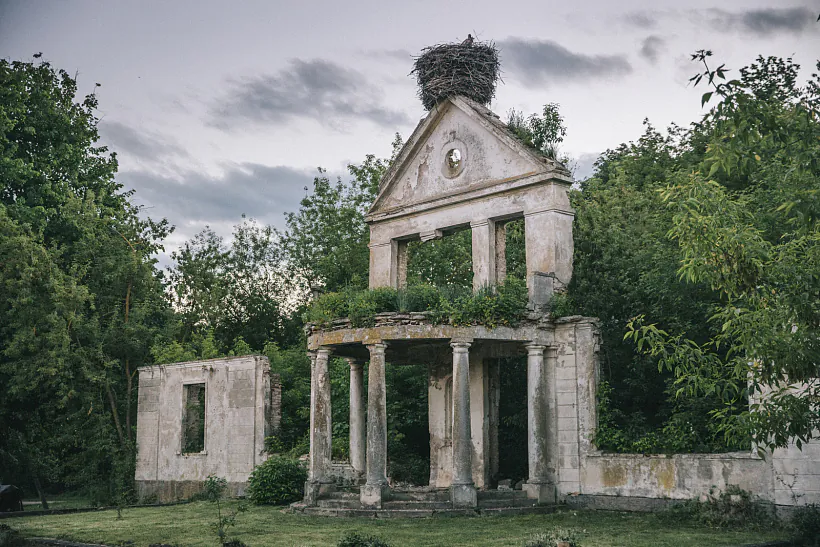
Photo of the Wolski family estate in our time. Photo: 34mag.net
Originally, the complex had more buildings, but after the arrival of Soviet rule, the estate was nationalized, and the outbuildings were rebuilt or demolished. In 2017, due to neglect, part of the estate's facade collapsed.
Muravanka — Between God and Music
Next, the path leads to Muravanka — a village in the Shchuchyn district. If you haven't seen the Church of the Nativity of the Theotokos yet, you will be pleasantly surprised by this marvel of defensive architecture. The temple has withstood numerous wars, and its mighty walls still preserve the spirit of a magnificent past.

Church of the Nativity of the Theotokos in Muravanka. Photo: bel.wikipedia.org
Built in the 1520s-1530s with funds from Vilna deputy cup-bearer Shimko Matskevich, the church organically combines Gothic and Renaissance styles. Almost square in plan, covered with a high roof, the church is topped with a semicircular altar. Four cylindrical defensive towers rise at the corners, containing spiral staircases. These led to a space under the roof, where a battle gallery was located. Embrasures were arranged along the entire perimeter of the temple and in the towers, and in the church's underground — a storage for weapons, ammunition, and religious valuables.
The church in Muravanka is one of the most outstanding monuments of defensive church architecture in the Grand Duchy of Lithuania. Similar to the St. Michael's Church in Synkavichy, it has a more perfect structure. The temple was changed multiple times, especially during major renovations in 1822 and 1871-1872. Some characteristic details that created the unique charm of the fortress church disappeared. Part of the embrasures on the main and side facades were walled up, and the embrasures on the eastern side disappeared.

Church from different angles. Photo: vedaj.by
New cornices were made, and a narthex was built. Plaster appeared on the outer walls. However, despite significant changes, the original appearance of the temple largely remained.
During World War II, the church was damaged; in the late 1940s – early 1950s, the walls, vaults, and roof of the temple were repaired.

Main altar. Photo: planetabelarus.by
Staryja Vasilishki. Homeland of Czesław Niemen
After the stern beauty of Muravanka, we head to Staryja Vasilishki in the Shchuchyn region.

Staryja Vasilishki. Photo: bel.wikipedia.org
This place is iconic for every admirer of Belarusian and Polish musical groups of the second half of the XX century. The legendary Czesław Niemen (Wydrzycki) was born and raised here — a renowned musician and artist, one of the most famous Polish performers of the XX century.
The Czesław Niemen Museum opened in Staryja Vasilishki in 2010. It is located in the house where Czesław Wydrzycki lived until he was 19, before moving to Poland, where his musical career began.

Czesław Niemen House-Museum. Photo: bel.wikipedia.org
A new wave of recognition came to Czesław Niemen after his death in 2004. Many fans of the performer admit that they did not immediately fully appreciate him. In the early 2000s, tourists began to flock to Staryja Vasilishki to see where Niemen grew up. The house, built by the musician's grandfather, was then vacant. Now, the local museum has collected various materials related to Czesław's work, and the environment in which the future musician lived has been recreated. The Czesław Niemen Club-Museum is open from 10:00 to 19:00 (closed on Monday, Tuesday).
The main architectural attraction of the village of Staryja Vasilishki is the Church of Saints Peter and Paul, which was built here in 1903. The temple rises above the surrounding buildings and is visible from afar.

Church of Peter and Paul. Photo: bel.wikipedia.org
The church was erected with voluntary contributions from parishioners, whose names are carved on the limestone blocks of the plinth. During the Soviet era, by order of the local authorities, the names of the donors were covered with cement. The architectural composition of the temple is subordinated to a strict vertical orientation. The main facade is distinguished by lancet openings, filled with ornamental intricate tracery, and a rose window in the center. The interior of the temple is also impressive: the main altar, 2 flanking altars, and 2 side wooden altars, the ambo, and benches for the faithful are all executed in refined Gothic forms.

Interior of the church. Photo: bel.wikipedia.org
Inside the church, unique artificial caves, created in the left nave of the temple, have been preserved. The church is currently fully restored and has the status of an architectural monument.

Plaque in memory of Czesław Niemen in the church. Photo: bel.wikipedia.org
Across the River and Bridge — to the Turquoise Dream
After passing through the town of Masty, be sure to stop by the famous suspension bridge over the Neman. The famous 193-meter pedestrian suspension bridge over the Neman is the longest in Belarus!

Pedestrian bridge in Masty. Photo: planetabelarus.by
Local legends say that the town got its name from the many wooden bridges that were built here from the 15th century on the route between Vilna and Krakow and were constantly destroyed by floods. The pedestrian bridge was built in 1972 and later extensively reconstructed: its decking was renewed, steel cables reinforced, glass elements and impressive night lighting were added. A walk across it offers a small dose of adrenaline and wonderful views of the wide river.
Previously, the bridge was often called "dancing" because it would sway from the footsteps during youth gatherings. In the modern town, the structure is more stable, but a slight sway and adrenaline remain the main attraction for tourists.
Blue Beauty near Krasnaselski
The final destination of the journey — the Krasnaselski chalk quarries. When you first see aquamarine-colored water framed by white chalk slopes, it's hard to believe that you are in Belarus, and not at some distant resort. This place reminds us that nature can always surprise, if given the opportunity to transform industrial scars on the earth into something incredibly beautiful.

Chalk quarries. Photo: bel.wikipedia.org
The development of the first quarry near Krasnaselski began in 1914 by the enterprise Krasnaselskblyzsmaterials. Subsequently, chalk extraction expanded, but now most of the quarries are not used. Thanks to potassium salt, the water in them has acquired a beautiful turquoise hue.
In 2023, an observation deck was installed near one of the quarries. "Krasnaselskblyzsmaterials" offers excursion services near the chalk quarries. And this initiative is not unfounded: many tourists travel to the quarries to see the blue beauty with their own eyes.
-
Lukashenka in Hrodna mentioned Tsikhanouskaya in Ukraine and spoke about the difficult fate of Belarusian doctors in the West
-
"They are outsiders!" Lukashenka is ready to take back doctors who went to work abroad, but only to wash dishes and take out the trash
-
«Looks like a joke». A Belarusian was charged 3740 BYN for 6 minutes in roaming
Now reading


Britain cannot deport a Belarusian for 25 years — he lies to Belarusian authorities, claiming he's not one of their citizens. And they won't take him home

Britain cannot deport a Belarusian for 25 years — he lies to Belarusian authorities, claiming he's not one of their citizens. And they won't take him home


The Goat from the Vikings and 'the Stern Orderliness of the Belarusian Song'. What was written about Belarus in a propaganda magazine during the occupation


Comments