


Bialiatski on his first day of freedom: Psychologically, I'm still somewhere there, but the situation is not new to me
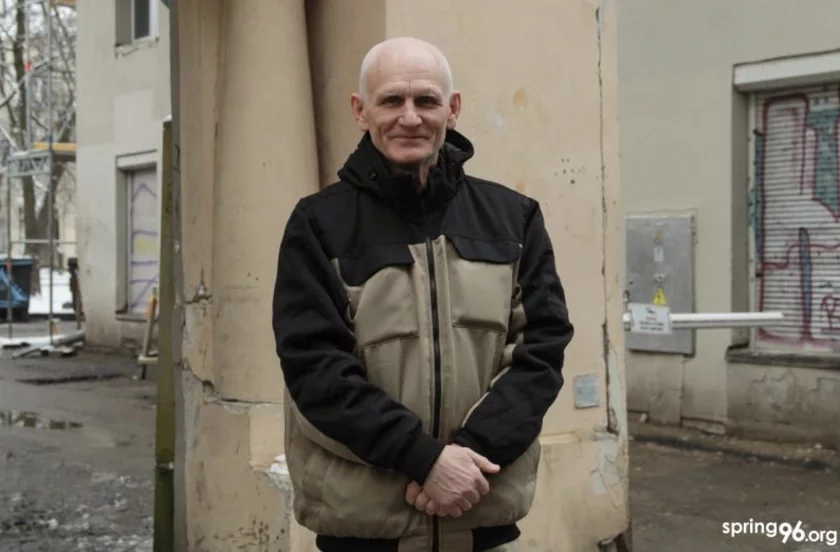
Nobel laureate and head of the Viasna Human Rights Center Ales Bialiatski has been released. In his first interview with Viasna, he spoke about the night of his release, the journey from the penal colony across Belarus, his psychological state after prison, the fate of political prisoners who remain behind bars, and why simple release is not enough without an end to repression.
About the Release
Overall, yesterday was a bit of a crazy day — probably, like for all those released. Firstly, there was a sudden change in situation. When you are under constant pressure and constant challenges that you have to resolve, that potentially hang over you — it's quite a psychologically difficult atmosphere. And this lasted for more than a year. Then suddenly you emerge from it into the free world. Naturally, a person is under great psychological impact. I am no exception.
Although I've been through this before, ten years ago, when I served my first term. Now the situation has practically repeated itself: I was released early then and now I'm released early again. I served only half of the ten years that were set by the court (there, counting one day as one and a half in the pre-trial detention center, it came out to nine years and a bit). These half-terms for me were effectively due now, this winter. Another half-term would have had to be served until the end of the sentence.
And when you immediately step out into freedom, emerging from this situation, of course, it's not easy. Yesterday was a difficult day for me in terms of tension.
At four in the morning, the duty officer of the squad woke me up — and we are still checked every night: "yellow tags", "extremists", twice a night someone from the colony staff comes and checks what state we are in. We are under close supervision.
I've gotten used to ignoring it: someone stomps, and you automatically note in your sleep that it's probably them coming to check on you. Although sometimes they might shine a flashlight in your eyes, or even pinch you — to check if you're under the blanket. In short, that was my previous night.
At 4 AM, the duty officer woke me up and told me to come out. When I left the section, the head of the colony's regime department was there, who told me to pack my things urgently. I understood that this was probably it. Because the situation with the release of political prisoners had been topical in recent months. Analyzing it, talking to other political prisoners (as there are over two dozen political prisoners in the Horki colony), I understood that there must be further releases, further groups of released individuals. And, presumably, some of us would be in these groups.
That's how it turned out: only I was taken from our colony. I was taken out after a search, after my manuscripts for two books were confiscated — they remained there — all letters, all papers, my notes on the criminal case. All of this was effectively not allowed to be taken from the colony. I could not take out a single piece of paper from there.
After that, an hour of such a detailed search, I was released beyond the colony walls, put into a Chinese car — and we drove across all of Belarus from east to west. Let me remind you that I was held in Colony No. 9 in Horki, which is practically on the border with Russia — 14 kilometers away. And, given that there were no large buildings nearby, the sky was visible very far, and sometimes I joked: "Look, it's raining from Russia" or, conversely, "it's raining on Russia," when the clouds moved back and forth.
I drove with my eyes blindfolded. The blindfold was pulled on in such a way that I could see something through it. At least, I understood that we were heading west. I understood when we passed near Minsk, when we drove along the ring road, I understood when we got onto the Vilnius highway that we were heading towards Vilnius.
Having approached Vilnius, we took a short break. And in the forest, we waited for four hours until other cars with other people arrived, who were designated for such a strange release — an amnesty or something else. Because they told me nothing: whether it was an amnesty, some extradition, or something else. To this day, they haven't told me anything about it, I haven't signed any papers. They just drove me somewhere.
They treated me very delicately — for the first time in many years. Although at first I was handcuffed and blindfolded, it was clear that we were getting closer and closer to freedom.
In this forest near the border, we sat for about four hours in the car. Then, when several more such cars arrived, bringing people from other colonies and from pre-trial detention centers (mostly citizens of other countries, but there were also several political figures), there were a little more than ten of us.
We were put into a minivan, and already together with the American delegation returning from Minsk, we drove right up to the border. It happened that we crossed the border together with the American delegation, who were returning after a meeting with Lukashenka.
There was a short meeting with the Americans at the border. And there, for the first time, I called my wife. After many years, we were able to talk. For more than three years, we had practically no contact. And already after five in the evening, I found myself in Vilnius.
This is still a very fast and rapid story. And psychologically, I'm still somewhere there: the adaptation process has not happened. Although, I repeat, this is not a new situation for me — I went through something similar in 2014 after my first imprisonment.
Currently, there are many meetings: with journalists, and with my acquaintances, friends. My wife arrived — we saw each other for the first time in so many years. I am now in constant meetings, in constant conversations.
This is extremely important for me, because we were in virtually complete informational isolation there: we could only watch Russian and Belarusian television, listen to news presented under a certain ideology.
And now, in order to objectively assess the situation and be able to say what has truly accumulated in my thoughts over these years of imprisonment, I am holding these consultations and meetings. In the near future, meetings will also take place at a fairly high level.
About Viasna
Being in Viasna all the time and being together with Viasna, naturally, all these years I felt like a part of Viasna. We perfectly understood that, despite our imprisonment, we remain a part of Viasna and continue to do our work there.
This is a rather paradoxical situation: when you do nothing, but continue to do your job. Because the mere presence of a human rights activist in detention is already a clear indicator of the absence of human rights and democracy in the country. Thus, we played a certain role as a marker of the level of absence of democracy.
It is very important that we were there together with hundreds and thousands of other Belarusian political prisoners, because we are part of Belarusian society, part of its active segment. We, together with Belarusian society, endured all the hardships that Belarusians have endured all these years — and continue to endure, because our friends remain imprisoned.
Now in this group of released people there is Uladzimir Labkovich, there is me. But Marfa Rabkova, Valiantsin Stefanovich, and our other friends and colleagues — journalists, human rights defenders, including Nastya Loika — remain. And it is very important to achieve, to await their release, so that this witch hunt, the search for "enemies of the people," which has been going on for all these recent years, ends in Belarus.
There is hope that all this will end. Although from what I've been told about recent arrests and detentions, it's clear that repression continues. A rather schizophrenic situation emerges: on the one hand, the authorities release political prisoners, on the other — they again arrest those whom they have not yet managed to imprison for one reason or another: "extremist activity" or other fabricated reasons. But all this remains vivid evidence that repression in Belarus continues.
It is very important to convey this idea to the international community: we must stop repression in Belarus. Because simply releasing political prisoners is not enough. Otherwise, this trade in political prisoners will continue indefinitely: some will be released, others will be imprisoned, and new concessions will be demanded for it.
We know that as a result of the release of this group of political prisoners, sanctions were lifted from Belkali. This is what the Belarusian authorities want. But we want fundamental changes in the situation with political prisoners in Belarus. Stop political prisoners in Belarus. It is impossible for this situation to continue.
To what extent we will succeed in achieving this — we will try in the near future. I, of course, must now take care of my health, psychological adaptation, legalization here, because I currently have a temporary visa to stay in Lithuania. After that, I will continue my human rights work to the best of my abilities — and those opportunities that I now have due to the Nobel Prize, as it provides certain, more significant opportunities than before.
I believe it is my duty — both to those who remain in prison and to the entire Belarusian society — to continue my work.


Comments
Карацей, чарга ў суды велізарная. Шчыра спадзяюся, што аўтарытэт Нобелеўскага лаўрэата дапаможа калі не знішчыць яе, то хаця б значна скараціць.