


What Matskevich, Karpau, Charniauskaya and others say about Babaryka and Kalesnikava's press conference
After the press conference of released political prisoners, which included Viktar Babaryka and Maryia Kalesnikava, opinions among Belarusians were divided. We looked at how well-known figures reacted.
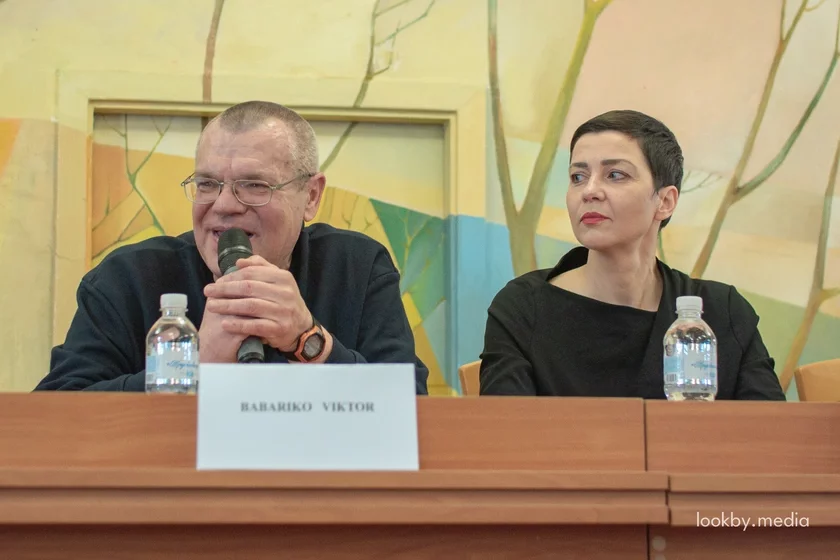
Entrepreneur and blogger Aliaksandr Knyrovich urges not to panic. Because, he says, we are talking to «guests from the past» — people who spent a lot of time in isolation in torturous conditions.
— We've already seen Tsikhanouski, haven't we, calling to take off masks and preparing to deliver a «decisive blow to the regime» with the forces of 5 new YouTube channels? You've seen him, remember? Let people breathe. For now, they need our love and acceptance more than their «position on the issue…»
He suggests for now, simply to be glad that people are alive, free, and have not lost their intrinsic spiritual qualities — faith, intelligence, external and internal beauty. For which they were once loved and trusted.
— Let's be «for them» for now, and talk about all other issues… in spring, okay?
Philosopher Uladzimir Matskevich, who himself was recently in the shoes of the released political prisoners, spoke much more harshly: «Sometimes it's better to chew than to speak.»
He said that he himself did not go to the press conference the day after his deportation, because he was sure: not all questions should be answered without first getting oriented in the situation. After all, four years in isolation is no joke. But there's a «but.»
— Some questions must be answered categorically, without evasion. Who is the aggressor. Whose Crimea. Who is the enemy. Who is a friend. And some others. But the situation has changed greatly over 5 years. And it is unethical to ask prisoners who were released yesterday questions about the situation. And they shouldn't answer such questions. Convictions are another matter. They can be supra-situational. People should not be scolded for their convictions. Convictions simply need to be taken into account. And taking them into account, decide whether or not to cooperate with people of certain convictions.
The philosopher is confident: who attacked whom could have been known even in the camp, even by reading regime newspapers and watching television. And he calls political correctness in this case cunning.
— It's clear that if the enemy holds loved ones hostage, then a person will choose an answer that does not harm their loved ones. Perhaps we heard answers of that kind at the press conference. From this arises the question of the ethics of such press conferences.
Matskevich concludes his post with a rhetorical question: Is it possible for journalists and PR specialists to refrain from hype on hot topics and sensitive events?
— Can the public be understanding of ambiguous and slippery statements from traumatized and disoriented people? Forgive carelessly uttered words?
Stas Karpau admits: he believes Babaryka would have been a good president for the country in 2020. But if elections were held in 2025, he would never vote for people who «sitting in the middle of Ukraine cannot call war a war and a criminal a criminal.»
— Tsikhanouski, who spent almost his entire term in an isolation cell, nevertheless, as we see, received enough information for reflection to figure out who's the asshole and who's the victim. The question is not even what access to information these people had in prison, but that by 2020 they had not accumulated conclusions about the world, about themselves, and about their neighbors.
Karpau believes: in fact, we saw a conference not only of the Belarusian liberated resistance, but also a press conference of «good Russians.»
— Belarus is an occupied country where «Russian law» is implemented in full. Our country, deprived of independence and identity, is a place where bad Russians oversee justice. And opposing them, as we see, were good Russians. Those who do not understand Ukrainian because they did not learn Belarusian. Those who advocate for fair and incorruptible justice from Anadyr to Brest.
Stas Karpau writes that he used to be annoyed by Tsikhanouskaya sometimes, and almost constantly by Tsikhanouski. But he only felt ashamed after the recent press conference.
— First and foremost, I am ashamed of myself, ashamed of how decisively and uncompromisingly I chose between bad and good Russians in 2020.
Nasta Rouda, director of Nasha Niva, thanked Ukrainians for accepting Belarusian political prisoners, for organizing the press conference and giving them a chance to be heard.
— And on the other hand — what a pity that it was not a press conference for Belarusians. I'm waiting for another one, because so many questions remain. And I hope that all of them will soon finally be given the opportunity to emerge from the information vacuum that has lasted for years. Let's wait for that moment before drawing conclusions. Well, Masha's smile is inspiring, of course!
Former political prisoner, anarchist Mikola Dziadok wrote:
— The only thing pro-democratic Belarusians are not prepared to quarrel endlessly about is unconditional support for Ukraine. Any politician or opinion leader who does not share this platform will very quickly cease to be both a politician and an opinion leader. I ask our Ukrainian friends to firmly understand this too.
Aliaksei Liavonchyk spoke as concisely as possible:
— As before, I believe that those who have been released have several months of indulgence for their statements.
Journalist Dzmitry Hurnievich decided to comment on the press conference from afar:
— «Oh f***, freaks, those f***ing b******s.» These few words were said to me by a man from Belarus on February 24, 2022, when early in the morning he heard three words from me: «Russians are bombing Ukraine.»
Hurnievich emphasizes: his acquaintance had not read hundreds of books, did not know how to seek information from various sources, did not reflect on the theses of Ortega y Gasset, he had never even heard of him and probably never would.
— He does not live in a big city, watches entertainment shows on Russian television in the evenings, drinks moonshine and dances at corporate parties to Philipp Kirkorov. In fact, he has been incommunicado all his life. But he gave an impeccable moral assessment of evil, although he has the right to a million excuses.
Director Mikalai Khalezin writes that he has now learned: any person who has spent five years incommunicado will say what people don't want to hear from him.
And that even famous people lose the skill of communicating with an audience — because the world changes very quickly, and what was «normal» five years ago has been «cringe» for several years now.
— For five years you didn't check your phone, and therefore you don't know current memes. What about memes — you've never even heard elementary words like «cringe,» «skuf,» or «crush.» Not to mention that «Aliaksandr Ryhoravich» has long been pronounced much shorter — «grandpa.» And his meeting with «Uladzimir Uladzimiravich» — «two grandpas.» And also, you don't know that if you drive from Belarus through Chernihiv region and reach Kyiv, and then turn right, you will get to Bucha. The very Bucha that a modern person cannot not know — just as one cannot not know Auschwitz, Srebrenica, or Khatyn.
Khalezin also recalls one of the pieces of advice from former political prisoner Pavel Vinahradau:
— Recently, on one of the «Svaboda» streams, when the host asked him what he would recommend to those who had just been released after a long imprisonment, among other things he replied: «When you play outside, don't eat yellow snow.» And he also recommended not to give interviews until you have looked around and understood how this world is now arranged. In this, I completely agree.
Politician Yury Hubarevich believes: explaining what was heard from Babaryka and Kalesnikava at the press conference solely through the prism of incommunicado, informational isolation, and regime pressure, including threats to relatives, is insufficient:
— Such an explanation seems convenient, but insufficient. Belarusian practice knows many examples of politicians who were released from imprisonment with a clear and unambiguous position, including on issues of war, occupation, and responsibility. It also knows examples of those who did not refrain from public assessments, even with loved ones behind bars.
He sees in Babaryka and Kalesnikava's first public statements a signal about the limits and possible directions of the Babaryka team's future policy.
And he also speaks about the fact that the mandate a person had in 2020 is not automatically renewed.
— The status of a former political prisoner, undoubtedly, adds moral weight, but it does not replace lost trust and does not remove the need for a clear value-based position. In this sense, the war in Ukraine is not an informational but a value-based test, which requires not complete awareness, but basic moral orientation. Vague or evasive formulations here are read not as caution, but as a conscious choice.
Yulia Charniauskaya spoke modestly:
— I believe that press conferences by people who were released yesterday, after years and years of imprisonment, especially incommunicado, are immoral.
Biaspalau: Babaryka is trying to work for those inside the country. Give them space, don't interfere
Losik: Incommunicado? Every reasonable person should have decided whose Crimea it was back in 2014
-
Turarbekava: The main question now is what part of sovereignty Lukashenka will agree to
-
On Veachka Stankevich's grave, the monument has not a single word in Belarusian. This is what it says about emigrants, emigration, and the "Belarusianness of grandchildren"
-
Moroccan breakthrough into Ceuta: What was it? Could it be Washington's subtle revenge on Madrid? And will it affect the legalization of Belarusians?
Now reading


DDoS attack targets websites of several Belarusian media outlets simultaneously. It may be related to the sixth anniversary of the 2020 popular uprising and the "New Belarus" conference, which opened today

DDoS attack targets websites of several Belarusian media outlets simultaneously. It may be related to the sixth anniversary of the 2020 popular uprising and the "New Belarus" conference, which opened today


"Poland flourishes in Latin, Lithuania flourishes in Ruthenian". A patriotic masterpiece of the 17th century turned out to be a Russian forgery of the 19th century.

"Poland flourishes in Latin, Lithuania flourishes in Ruthenian". A patriotic masterpiece of the 17th century turned out to be a Russian forgery of the 19th century.
Statkevich: If mass protests start again, they will no longer be as peaceful as in 2020. And the EU has rightly stopped believing Lukashenka's fairy tales


Comments