


Free Kupala, laboratories, and a conference: what to expect at the Belarusian theater festival in Lublin
From December 8 to 14, Lublin will host the fourth stage of the "Блізкі Усход" ("Near East") theater festival.
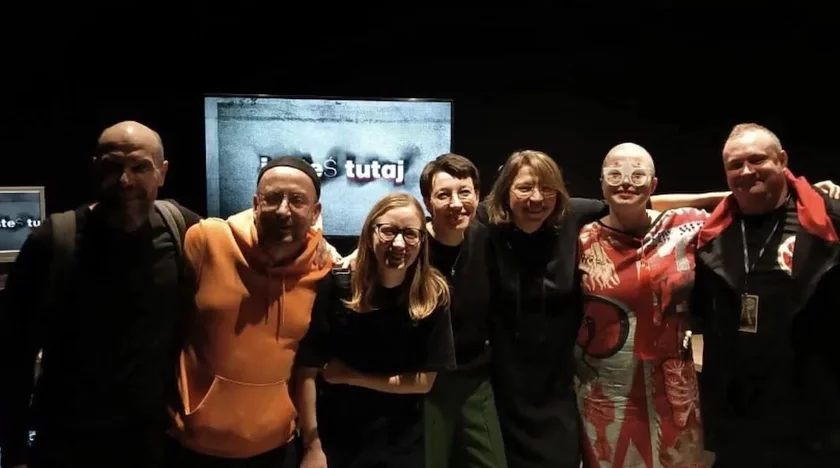
Admission to all events is free, but you need to get free tickets, and it's best not to delay this, because some halls, with 50-70 spectators, cannot accommodate everyone who wants to, says the festival curator Irina Lappo. "Budzma" talked with Mrs. Irina about the difficulties in preparation, festival traditions and features of the current festival.
— How did the idea of creating the festival come about? Where did it all start?
— If we talk about the beginning of the festival, we need to go back to 2020 - when the eyes of Europe, including Poland, turned to Belarus. A big role in creating the festival was played by the Lublin director Pavel Passini and the Belarusian Theater Institute (BTI), with whom we organized cooperation.
BTI is a community of theater people who, after the protests and dismissals, remained working in Minsk. At first we cooperated online, and then almost all of them had to leave and continue working in exile. And so, in a conversation with colleagues in theater and with Pavel Passini, the idea came up to make a Belarusian program at the "Divine Comedy" festival in Krakow ("Divine Comedy" is a Polish theater festival, which in 2021 included Belarusian performances as a sign of solidarity). We jointly developed the program, but it was held in a very limited form at the "Divine Comedy". Then we decided to do everything we had planned in Lublin. This is how the first edition of the "Blizki Uskhod" festival appeared.
— What is the name "Blizki Uskhod" about?
— A community with this name has existed in Lublin for many years. It was directed at the geographical Middle East, but after 2020, the gaze turned towards Belarus, towards the East that is very close to us, and this became a priority.
The first festival was dedicated to several cultures - Belarusian, Lithuanian, Ukrainian and Polish. Theater of four countries. That was in the beginning, but now "Blizki Uskhod" is a festival of Belarusian independent theater.
— And why is "Blizki Uskhod" held in Lublin? How did you choose the location?
— It so happened that many of us live and work in Lublin. We have a base here. You need to understand that to organize a theater festival, you need not only financial resources, which we receive through grants, but also a venue, technical equipment, resources. All this is available in Lublin, because it is here that the Center of Culture is located, whose activities are aimed at the east and helps creators from Ukraine and Belarus. Therefore, this is a very natural place to hold the festival.
— This will be the fourth festival. Do you feel any transformation? What has changed in these three years?
— What has changed is that at the beginning there was an idea of a festival of four cultures - Polish, Ukrainian, Lithuanian and Belarusian. But it quickly became clear that this is primarily a festival of independent Belarusian culture, which exists here in exile, next to Polish. We always strive to invite Ukrainian troupes to participate, but not with large programs. The most important thing is Belarusians, Belarus is primarily at the center of the festival. From the second edition, a young theater laboratory with a very interesting format began working at the festival. It is connected with independent culture, including book culture, which has moved into emigration.
The laboratory lasts five days. During this time, young creators work on a topic set by a Belarusian intellectual (Olgerd Bakharevich, Eva Vezhnovets, Yulia Timofeeva, Vladimir Lobach). They give a lecture, define a topic, and then theater groups - five groups, they are always different, in different configurations - work on this topic. They develop it, improvise, translate the idea, artistic text into a kind of theatrical statement. And in the evening, in the presence of the audience, you can see this "translation", these theatrical sketches that arose during the day. And the next day everything starts again: a new lecturer, a new topic, a new finale.
— Has any special tradition arisen during the existence of the festival? Something that you try to do every year? What has already become your festival "feature"?
— From year to year we strive not to lose contact with Belarusian writers, with publishers, with book people - this is an important part of our festival, you can say - a tradition. And another tradition is that every year we add something new.
For example, the laboratory appeared with the second edition, and the scientific conference appeared with the third, which traditionally opens our festival. There, scientists can record and comprehend what is happening in Belarusian theater in emigration. And our volunteers also began to publish a festival newspaper called "Blizka". It is published in Belarusian, English, Ukrainian and Polish - in all the languages that are heard at the festival.
— What difficulties do you face in preparing the festival? Maybe there is something that is not easy to do?
— Well, what is not easy to do... There are few of us, the organizers. There are mainly only three people - Pavel Passini, director and director of the festival; I am the curator; and Alexandra Kanarskaya, set designer and also the producer of our festival. Alexandra takes care of, for example, finances. This is the most important and the most difficult part, because there is no permanent funding, none at all. From year to year we write grants and never know: will there be another edition or not.
This is a traditional problem of theater funding. After all, theater is such an art that requires a material component: you need a room, you need money for scenery, you need to pay people, our entire creative project requires serious funding.
— What awaits the audience of the festival this year? Tell us a little about the program.
— This year's festival program will be dedicated to the Free Kupalauskians. The current festival will end with the play "Dziady", one of the first creative projects of the Free Kupalauskians in Poland, and we start with the premiere screening of the play "Wilcy". That is, such a slightly reversed program: from end to beginning. We are reviewing the main repertoire of Kupalauskians, created over four seasons in Poland, up to "Dziady", with which it all began.
The first day is "Wolcy" directed by Pavel Passini and five Kupala actors on stage. And the next day there will be the play "Where are you going, wolf?" by Polish director Monika Dobrovlyanskaya. "Wolcy" is a more plastic performance with bright, interesting scenography, costumes, unusual masks, puppets. And the second play - based on Eva Vezhnovets' bestseller "Where are you going, wolf?" - it is more linguistic, there are experiments with languages. It is played in Belarusian, Ukrainian, Russian and German.
And many more interesting, bright performances await the audience during these seven theater days in Lublin.
— How can I get to the performances? And is admission free?
— Yes, admission is free, but you need to take an entrance ticket before the performance. This can be done at the box office of the Center of Culture (ul. Peowiaków 12, Lublin). I advise you to take tickets for the performances in advance, because, unfortunately, in some halls with 50-70 spectators, we are not able to seat everyone who wants to. You need to act quickly here.
The program can be seen at link.
Now reading


Ihar Losik recounted how he was held in the KGB pre-trial detention center with a former delegate of the All-Belarusian People's Assembly — a police colonel who, while drunk, almost killed his wife


Comments