


Donald Trump's statements about the necessity to "acquire" Greenland have sparked sharp criticism in Europe and the broader expert community. They are called dangerous, imperial, undermining international order and NATO unity. But political scientist Pyotr Rudkouski suggests looking at the situation differently. In his opinion, behind the US's crude rhetoric lie very real threats to European security, and ignoring them is much more dangerous than discussing them.

Greenland. Photo: freepik.com
We talked with him about why, in his opinion, the scenario of Greenland's secession from Denmark is almost inevitable, what role China plays in this story, why comparisons with the annexation of Crimea are inappropriate here, and why the issue of Greenland is an element of security for the entire Western world.

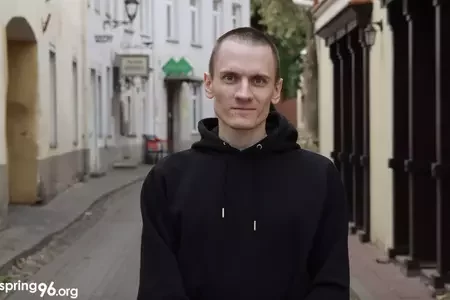
Pyotr Rudkouski. Screenshot from the YouTube channel "Bank of Ideas | Reforms for Belarus"
Greenland's Independence: Not "If", But "When"
— In expert circles, the opinion prevails that Donald Trump's claims to Greenland threaten world order and sow chaos in NATO. Why do you take a different stance?
— Why do I take a different stance — because I don't read the headlines of popular media, but instead read expert reports on Europe's critical dependence on China for rare-earth metals. I read about the unprecedented dynamics of China's presence in Greenland until 2017-2018. I draw conclusions from the short-sightedness of the EU when it approved "Nord Stream 1" and "Nord Stream 2", thereby making itself dependent on Russia and arming Russia to such an extent that it could afford not to fear the West and attack Ukraine.
The trials for European security did not end in 2022, just as they did not end in 2014. Even more serious trials lie ahead. China's attack on Taiwan is a completely realistic scenario. Russia's attack on NATO countries is also a probability that must be taken seriously. Greenland under China's economic control is not the only, but one of the serious threats to European security.
— On Facebook, you wrote that Greenland's secession from Denmark is practically an inevitable process. What factors make gaining independence only a matter of time? And where, in your opinion, is the line between the legitimate will of the people and geopolitical coercion from major powers?
— Firstly, the overwhelming majority, reaching 85%, of Greenlanders are for secession. Secondly, there is not a single party on the island that would oppose [secession]. Thirdly, this trend is stable and has persisted for many years. Theoretically, one can imagine that through a massive media campaign or aggressive external interference, this process could be averted. But if we talk about the sentiments of the Greenlanders themselves, they are clearly pro-independence.
What factors make gaining independence only a matter of time? Here, practically the only factor is economic. Greenland does not have a ready answer to the question of how to build its economy after seceding from Denmark.
The boundary between "legitimate will of the people" and "geopolitical coercion" in this particular case is quite well defined in the Self-Determination Act: a referendum. Since both Denmark and Greenland are legal and democratic countries, there is no doubt that the referendum will be fair. This will be the indicator.
— What position do the Greenlanders themselves take in this geopolitical confrontation? Is there an internal consensus on the future of the island — independence, partnership with the US, or other scenarios?
— Regarding the path to independence — yes, there seems to be a consensus. As for when and how to implement it — that is an open question.
In society, the following position prevails: "We don't want to be Americans or Danes, but we want to be Greenlanders."
And this is completely understandable: the discussion about the future is still ongoing, and it would be unwise to commit to any specific scenario right now, such as a free association with the US. If only for the reason of maintaining room for maneuver in negotiations with the US. I will only note that the idea of association with the US is also being considered, but unofficially.
— In public discussion, parallels are drawn with the annexation of Crimea and Russia's actions in 2014. What is the difference between the cases of Greenland and Crimea from the perspective of international law?
— It is important to realize the colossal difference. Greenland is a country with an internationally recognized right to self-determination, enshrined in a special Act from 2009, in which Denmark itself confirmed this right. In practice, this means that if Greenlanders vote "for" secession from Denmark in a referendum and declare independence, they will not violate either international law or the Constitution of Denmark.
In the case of Crimea — it's entirely different. It did not have an internationally recognized right to self-determination; there was no analogue of the 2009 Act. Even if a transparent and clean referendum had been held there and the majority had voted to withdraw from Ukraine, that step would still have been illegal.
If someone wants a historical analogy, Crimea is not suitable here, but, for example, India in the 1950s. Of course, the procedures there were different, but the legal aspects are very similar.

Photo: ctrcenter.org
"Trump's Pressure — Believe Me, Is Far From The Worst Thing That Can Happen In Europe"
— Until 2016-2017, Greenland actively sought economic rapprochement with China. For example, in 2017, the then Greenlandic Prime Minister Kim Kielsen visited Beijing, considering Chinese investments in the island's infrastructure. Why is such a course today perceived as potentially dangerous — for Europe and the US?
— Chinese companies claimed the Kvanefjeld and Isua deposits. This would give Beijing a 90-95% monopoly on the world market for heavy rare-earth metals. Why is this dangerous? Without these metals, it is impossible to produce modern weapons — missiles, F-35 fighter jets. It is also impossible to implement the EU's key image-building course, the so-called "Green Deal" — electric vehicles, wind generators.
But that's not all. Everything was leading to the Chinese, as main investors, gaining control over three Greenlandic airports. What would this mean? Airports are objects of potential dual-use. In the event of a conflict, they would become a brilliant gift to Russian or Chinese military aviation.
This is far from a complete list of threats posed by the Chinese presence. I refer those interested to expert reports on the topic — they are easy to find online.
I will note two things here. Firstly, it's not entirely true that the West saw the danger. The big problem is that the West saw no danger at all. And only when the "odious" Trump threatened to annex Greenland in 2018 did the West wake up.
Secondly, what was done after 2018 is a superficial and temporary solution, with unpleasant side effects. China is still dragging Greenland through courts demanding compensation for losses almost equal to four times the island's annual GDP! Since the court is in Copenhagen, it did not satisfy the Chinese plaintiffs, but this casts a shadow on Europe as a predictable and business-friendly legal space. All this would have looked entirely different if Western politicians had thought about all this before the Greenlanders concluded deals with China. But at that time, no one thought about it.
— Let's look broader: why does the question of Greenland acquire significance for the entire Western security system?
— From what I've read from security experts, the situation looks like this. Greenland is the beginning of an extremely important maritime corridor between it, Iceland, and Great Britain. This is a bottleneck through which the Russian Northern Fleet must pass to enter the Atlantic. If NATO effectively (precisely effectively) controls Greenland, then they can "close the door" for Russian submarines. If Greenland falls under China's influence, this stopper disappears. Russian submarines get the opportunity to freely hunt American ships that, for example, are bringing reinforcements to Europe in case of war.
So keeping Greenland in the economic and military zone of the West is not some whim of Trump's, but a matter of security for the entire Western world. Europe needs this no less than the United States.
— A number of experts emphasize: public statements from the US look like pressure. Do you not see in the US rhetoric a dangerous return to the logic of great powers that view territories as objects, rather than subjects, of international politics?
— Trump's public statements do not look like pressure, but *are* pressure, moreover, brutal and brazen pressure. Similarly brutal and brazen was the pressure in 2018, after which China's expansion in Greenland was paralyzed. Although then, and now, there was much lament and indignation — how can this be! — I am convinced that after February 2022, many of the more sober European politicians recognized how useful that pressure was. How could sanctions be imposed if Europe felt the ominous breath of a Kremlin ally from the North?
That pressure exerted by Trump — believe me, is far from the worst thing that can happen to Europe.

Donald Trump. Photo: Chip Somodevilla / Getty Images
— Donald Trump openly stated that possessing Greenland is an "absolutely necessary condition" for US national security and the economic security of the West. The island is rich in minerals — rare-earth metals, uranium, oil, and gas, and all of this is needed by the US. Can such arguments be considered justified in the 21st century, or is this rather the logic of resource politics of past centuries?
— Exactly: we must live in the 21st century, not in the illusion of the "end of history" characteristic of the 1990s and early 2000s, when Russia had to think about how not to fall apart into 50 pieces, and China could not even closely match the economic power of the West.
In the 21st century, in the third and subsequent decades, the situation is fundamentally different. Russia, despite all its economic and image problems, remains a powerful and aggressive player. China is an economic giant that is rapidly taking all previous trump cards from Western Europe, including leadership in the development of "green" technologies. In terms of rare-earth metals, Europe is now critically dependent on China.
The time for lofty words has passed. If the West wants to survive as a realm of democracy, human rights, and prosperity, it must take the issue of security — both military and economic — seriously. I don't like Trump's hints at military intervention, but one thing is clear: belligerent hints are better than deepening dependence on China.
— What role does the European Union seek to play in the question of Greenland? Does Europe have a common strategy to strengthen ties with Greenland and prevent its drift towards competitors of the West?
— For a long time, Brussels communicated with Nuuk through Copenhagen. But in 2024, the EU opened its official representation directly in Greenland. The US opened a consulate, as far as I remember, during Trump's first administration. There is an EU Arctic strategy, developed in 2021. After 2018, something started to be done, but it's difficult to speak of a comprehensive and long-term strategy here.
— Do you not see the risk that the story with Greenland could become a dangerous precedent — if major powers begin to openly "discuss" the future of territories without their initiative?
— If someone wants some precedents, they will find many in recent history, and much better and more eloquent ones than the American-Greenlandic one. The bombing of Serbia, the war in Iraq, military interventions in Libya or Syria — as precedents, they are vastly more suitable for Russian or Chinese propaganda, because there were thousands of casualties there. This is much better material than some verbal threats that many perceive as a method of raising stakes.
«Nasha Niva» — the bastion of Belarus
SUPPORT US




Comments