


The coordinator of Viktar Babaryka's campaign headquarters, who became one of the symbols of the election events, was arrested on September 7, 2020. Security forces tried to expel her from Belarus, but Maria tore up her passport at the border and remained on Belarusian territory — one of the most dramatic moments of 2020. Kalesnikava was sentenced to 11 years in prison. In prison, Lukashenka's regime imposed an incommunicado regime on her; her family knew nothing about Maria or her health condition.

Maria Kalesnikava has been released. As with the release of Siarhei Tsikhanouski, Aliaksandr Lukashenka handed her over to the American delegation that arrived in Minsk. It seems that the condition for her release was Maria's departure abroad.
According to "Nasha Niva", Kalesnikava was recently transferred from the colony to the pre-trial detention center to be fed before her release and to give her a more presentable appearance.

Maria Kalesnikava was born on April 24, 1982, in Minsk. Her father, Aliaksandr Kalesnikau, served on a submarine and taught at an aviation college; her mother was also an engineer. In her teenage years, Kalesnikava was a Young Front activist, but later moved away from political activity.
Maria graduated from the Belarusian State Academy of Music with a specialization in flute and conducting. From the age of 17, she taught flute at a gymnasium in Minsk. She played the flute in the opera theater, the Finberg Orchestra, and the Presidential Orchestra. She studied at the Stuttgart University of Music in the departments of ancient and contemporary music. She worked in Germany, participated in concerts, and organized international cultural projects in Germany and Belarus.
In 2017, Belgazprombank, whose chairman was banker Viktar Babaryka, bought three empty workshops of the Minsk Machine Tool Plant. The former factory premises were converted into a cultural hub â OK16. This place was intended to become an incubator for cultural projects and future economic tools. Maria Kalesnikava became the art director of the project. It was thanks to this project that Babaryka and Kalesnikava met.
When the banker announced his presidential ambitions in May 2020, Maria joined his team.
After the arrest of Babaryka and his son Eduard, Kalesnikava took over the headquarters. When Babaryka was arrested and denied registration as a presidential candidate, the headquarters merged, and Maria began working in a joint team with Sviatlana Tsikhanouskaya.
Kalesnikava remained in Belarus, participated in protest marches, and became a member of the Coordination Council.
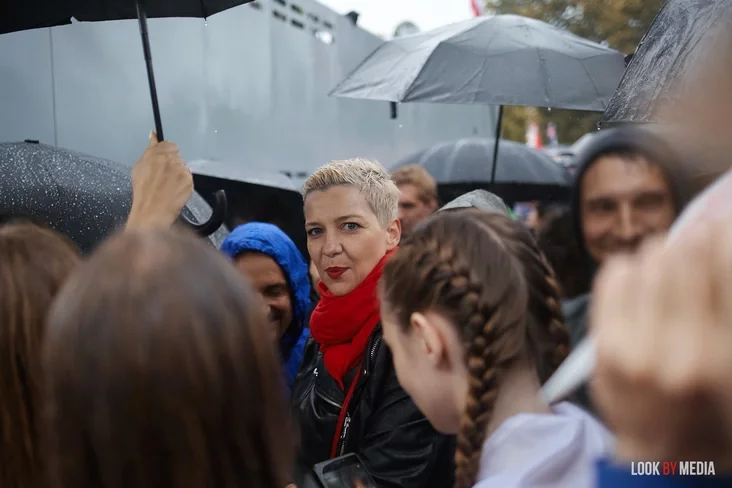
Maria Kalesnikava. Photo by LookByMedia
Maria was arrested on September 7, 2020. They tried to forcibly take her out of Belarus to Ukraine, but she tore her passport at the border and consequently remained on Belarusian territory. The next day, she was placed in a pre-trial detention center. There, she was held in isolation from other detainees.

Kalesnikava was sentenced to 11 years in prison. The charges included "conspiracy to seize power by unconstitutional means," "creation of an extremist formation and leadership of such a formation," and "public calls for the seizure of power."
In the Homel colony, Kalesnikava was held incommunicado, often thrown into a punishment cell (SHIZA) and a cell-type room. Over five years, she was allowed only a few meetings with her father.


Comments