


A Candid Book About Emigration, Seen Through the Eyes of a 25-Year-Old EPAM Employee, Has Been Published
Darya Rakava moved to Poland in 2018 at the age of 18 to study. In emigration, she experienced COVID isolation, the inability to visit Belarus after 2021, the start of the war in Ukraine, and changes in attitudes towards Belarusians. She now teaches Polish as a foreign language and works at EPAM. Her book "I/We Emigration" could serve as a warning or, at least, an acknowledgment of the future awaiting young people who have chosen emigration, writes Zosia Lugavaya.
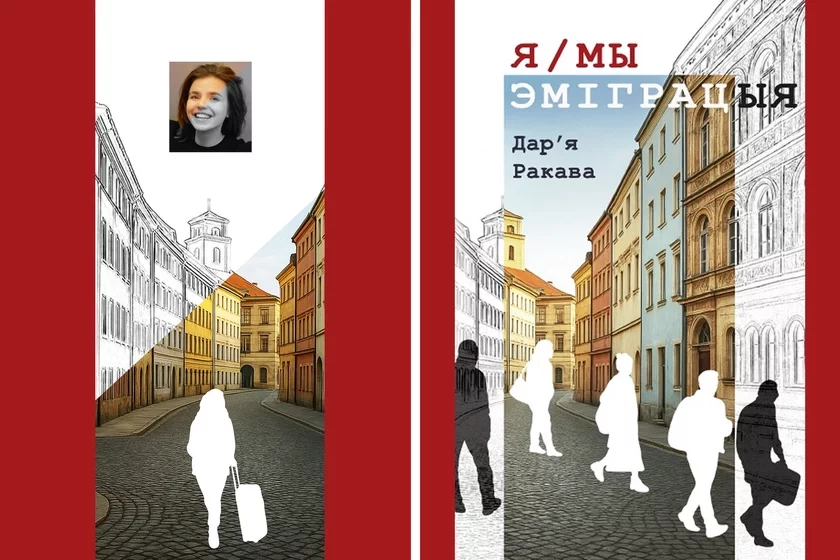
"I/We Emigration" is a look at emigration through the eyes of a very young girl. It's a simple text in form, but full of empathy, (self-)irony, and interesting observations on emigration. Darya moved to Poland at 18: she studied at university, worked part-time, and learned the language.
Darya teaches Polish as a foreign language. She has many students and a fairly large sample group, as she herself states. And what she starts with is language.
"In a new country of residence, you remain silent for a long time. At first, you lack the words. And you often hear from all sorts of people where you should go, how you're 'not like them', and how awkward you are if you do decide to open your mouth. Discrimination becomes such a common part of life that by the time you have enough language to respond to everyone, you continue to remain silent, having believed in your own inferiority. You pay taxes, do useful work like the locals, have good experience and several languages in your head, but you're still 'superfluous' and you live with this, shyly keeping your mouth shut."
Much begins and ends with language; language gives freedom. And this is precisely the topic that will resonate with emigrants of any age. Darya arrived in Poland with a B2 level, but this was catastrophically insufficient for full communication. It will take more than a year or two to achieve comfortable existence in a new linguistic environment, even with intensive study.
 "In a few seconds, I had to understand what the person was telling me, what they meant, and what they expected from me. Everything ended at the first stage: I only understood the words... When I could finally sustain a conversation in Polish, it turned out I could only manage fifteen minutes."
The second important theme resonating throughout the book is friends. How old friends are lost, and how difficult it is to make new ones with whom you don't share common cultural codes, understandable jokes, or books or TV shows known from childhood.
"Friends with whom we agreed to always stay in touch dissolved over time. Or, rather, dissolved in trauma."
Darya reflects on how formats of friendly communication differ in Belarus and Poland. And on the fact that one's own people, bridge-people, can be found in any culture, but it takes time. Because the trauma of emigration, the author reminds us, is compared by psychologists to the loss of a loved one.
Having emigrated to neighboring countries, Belarusians learned that their neighbors know very little about them, if anything at all. Of course, this question can also be asked of ourselves: what do we know about our neighbors? But Darya primarily speaks of the invisibility of Belarusians to Poles and regular dialogues like this:
â You have such a pleasant accent, are you from Ukraine?
â No.
â From Russia.
â No.
â From Lithuania?
â Guessed wrong again.
â Well then, only Kazakhstan is left.
â I'm from Belarus.
Another important topic the author reflects on is home. Every emigrant sooner or later catches themselves wondering: where is my home? Am I home yet or not? When can one start buying furniture, beautiful dishes, and creating coziness, even in a rented apartment?
"What if I never get citizenship? Or my own apartment? Will I die without ever drinking wine from my beautiful glasses? I don't have money for my own housing and my chances of getting a passport are slim, but I do have fifty zlotys for a glass. And I have a great desire to no longer live a postponed life."
The author also touches upon the topic of family, relationships, and children. At first, it seems unlikely that a young girl could say anything new to those who are significantly older, married for years, and have children. But Darya speaks to the point: not only does your partner reveal themselves to you in a new light in emigration, but you also discover new sides of yourself. An interesting thought, for which I immediately found half a dozen confirmations among friends and acquaintances, is the differing paces of adaptation and their consequences:
"One strives to adapt, while the other freezes for several years. You'd be surprised, but this greatly depends on language learning... The one who learns the language solves major legalization issues and minor everyday concerns. Through mistakes and shame, they begin to function fully. If the other partner doesn't try to learn, they naturally become dependent."
And quite unexpectedly, but immensely joyful, it was to read about children and teenagers, about the necessity of prioritizing the native language for the very young, because they will learn the local language in the playground, kindergarten, or clubs.
"â Darya, my son is four years old, could you work with him? We're moving in two months..."
"â I won't. When you arrive, send him to the sandbox with local children. In about three months, he'll be teaching you. It's better to then focus on lessons in his native language for him from about six years old."
Unlike toddlers, the most vulnerable group in emigration are teenagers. They are no longer children, for whom a simple language level suffices and who learn it very quickly. But they are also not yet adults, who possess life experience and self-control tools. Â
"Being parents to a teenager is difficult. Being parents to a teenager in emigration is even more difficult. And do you know what's the most difficult? Being a teenager yourself."
"I/We Emigration" is a book where there's a little bit of everything, but all of it relevant. At times, the author speaks in the language of popular psychology, but she says good things: not to accept criticism from someone you wouldn't ask for advice; that adaptation in emigration is not a linear process, and for the first five years, we swing on the pendulum of progress and regression; the decision to return is normal in essence, but can be difficult to execute, because "in our culture, it's not generally accepted to get into something only to then get out of it."
Sometimes it bothered me that the author says "assimilation" where, in my opinion, "integration" should be, because personally, for my children, I seek the latter and would like to avoid the former for as long as possible. Perhaps these are age differences: Darya emigrated at 18, I at 38. But, perhaps, in saying, "I am simply a first-generation Belarusian emigrant in Poland, and Poland is my home," the author is right.
The book was published by the new Belarusian publishing house RozUM Media, which was founded in 2025 in Poland. The publishing house bets on new voices and candor, open to young authors. Several books are already available for purchase on the publisher's website â in Belarusian and Russian, in electronic and paper formats.
Darya Rakava. I/We Emigration. â Poland: RozUM Media, 2025
Now reading


Have Belarusian authorities decided to destroy all manifestations of "Polishness"? The authorities are quietly preparing a global purge of the State List of Monuments


Comments
Не не не, мусим адрозьниць яе ад вымушанай эмигрантки ад дваццатага.