


Norway is building the world's longest and deepest underwater road tunnel.
The Rogfast road tunnel will be 27 kilometers long with a maximum depth of 392 meters below sea level. The project includes two separate tubes with four lanes of traffic and a unique underwater roundabout.
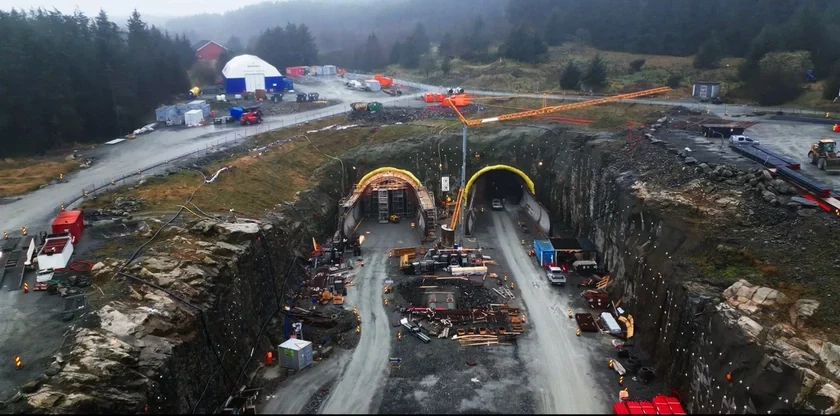
Norway is implementing a grand engineering project that will forever change the transportation system of the country's west coast. As CNN reports, it should reduce travel time between major cities and become part of a highway without ferries.
The tunnel is called Rogfast. This is an abbreviation of "Rogaland fastforbindelse", formed from the name of the Rogaland region and a Norwegian term that means "permanent connection". It will be 27 kilometers long, and at its deepest point it will pass 392 meters below sea level. There have been no underwater road tunnels of this scale in the world yet.
The first work began in January 2018, but construction was suspended at the end of 2019 due to a projected budget overrun. After a review of contracts and restructuring of the project, work resumed at the end of 2021. The total construction cost is estimated at approximately 25 billion Norwegian kroner (approximately $2.4 billion).
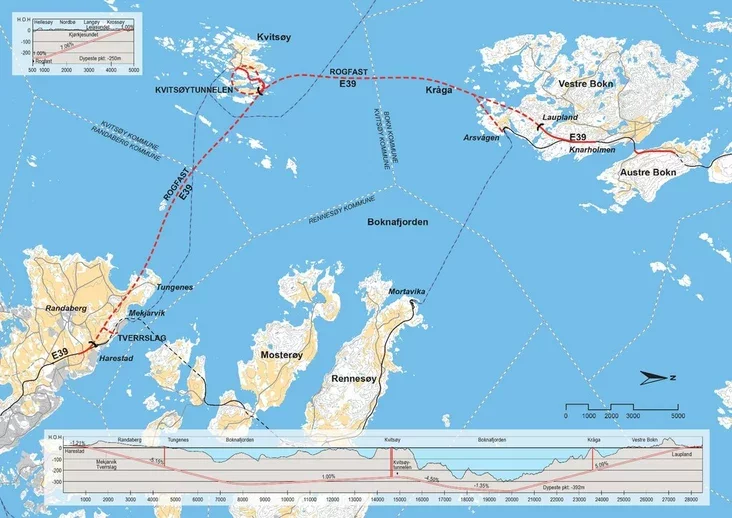
Rogfast should significantly improve communication along the west coast of Norway. The main practical goal is to replace today's ferry crossings. This will reduce travel time between the major cities of Bergen and Stavanger (respectively the second and fourth most populous cities in the country) by approximately 40 minutes and will make daily trips between them much easier.
Engineering challenges and innovations
According to the project, the tunnel will consist of two separate tubes, each with two lanes of traffic. One of the most interesting details is the underwater interchange: approximately in the middle of the tunnel, at a depth of 260 meters, a "ring" will be built that will connect the main route to the island of Kvitsøy - the smallest commune in Norway.
The construction of such a long underwater highway requires special technical accuracy. To speed up the work, the tunnel is being dug simultaneously from both ends. The goal is for the two teams to meet in the center with an error of no more than 5 centimeters.
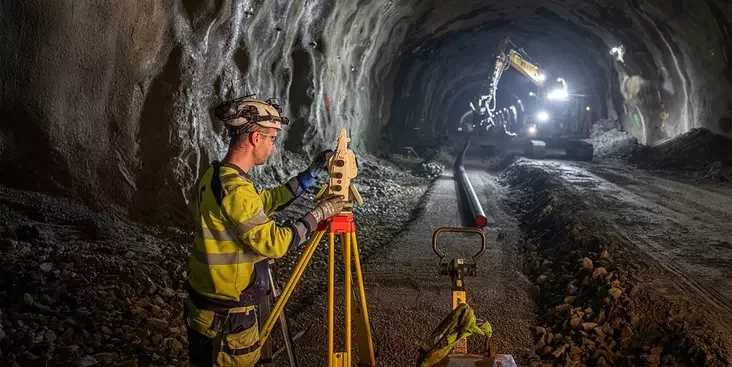
Such accuracy is achieved through a complex measurement system. A special laser scanner with a mirror rotates and scans each newly excavated part of the tunnel. It collects about 2 million data points per second and creates a "digital twin" of the tunnel, which is compared to the project plans in order to immediately identify even the smallest deviations.
The five-centimeter tolerance is one of the most stringent in the world, but it saves time, money and resources. If you deviate more, you will have to remove extra rock and then fill the voids, which means increased costs.
Although the project is moving forward, there are still difficulties. The main problem is sealing the rock from leaks of salt water under high pressure.
The tunnel also requires measures to protect motorists from air pollution. It will be equipped with a complex ventilation system. Powerful fans should create airflow along the route, and additional air exchange will be provided by a vertical shaft that will be brought to the surface of the island of Kvitsøy. It is estimated that this combination will guarantee safety and normal air circulation throughout the long route.
In addition, it is planned to introduce a real-time incident warning system (for example, breakdowns or traffic jams). Traffic will be monitored by cameras and radar.
Breaking: Norway is building the world’s longest and deepest undersea road tunnel. The Rogfast tunnel will stretch 26.7 km and reach 390–392 m below sea level, connecting key coastal cities and reducing reliance on ferries.
Follow: @globaltrendsX pic.twitter.com/DBKHK8MMVa
Impact on the region
This project is a key part of the modernization of the 1,100-kilometer coastal highway E39. Today, the journey along this route from Trondheim in the north to Kristiansand in the south takes about 21 hours and includes seven ferry crossings. Norway has an ambitious goal: to make the entire road ferry-free, cutting travel time in half. The completion of the entire highway is planned no earlier than 2050, but Rogfast should be ready as early as 2033.
The project is expected to improve logistics for the fishing industry, reduce business costs and expand the labor market, allowing people to more easily commute to work and study in neighboring regions.
.@SkanskaGroup is leading project Rogfast, building the longest and deepest subsea road tunnel to unite Norway. Our measurement #technology is ensuring #precision and #safety every step of the journey.
Dive in to discover how: https://t.co/sPnUlBee6D pic.twitter.com/tDHZ5gz42d
Today, the world's longest tunnel with an underwater section is Seikan in Japan. Of the total length of 53.85 kilometers, the underwater part accounts for 23.3 kilometers. The Channel Tunnel is shorter (50.46 km), but its underwater section reaches 37.9 km.
However, they are intended exclusively for rail transport. In addition, Rogfast significantly surpasses them in terms of depth: Seikan descends to 240 meters below sea level, and the Channel Tunnel to 115 meters.
-
Back to pen and paper and smartphone ban: universities are forced to change the format of classes and tests, otherwise AI prevents both teaching and assessment
-
Google launched Gemini 3.5 Transcribe for speech transcription. Belarusian is on the list
-
Tim Cook steps down as Apple CEO after 15 years of leadership


Comments
Надо было на какую-то соседнюю страну напасть. Вот тогда было бы окей...