


"New puppets released, we'll laugh soon." Bots comment on the release of political prisoners as if following instructions
Propaganda networks promptly reacted to the news about the release of a new group of political prisoners. We've gathered the main points.
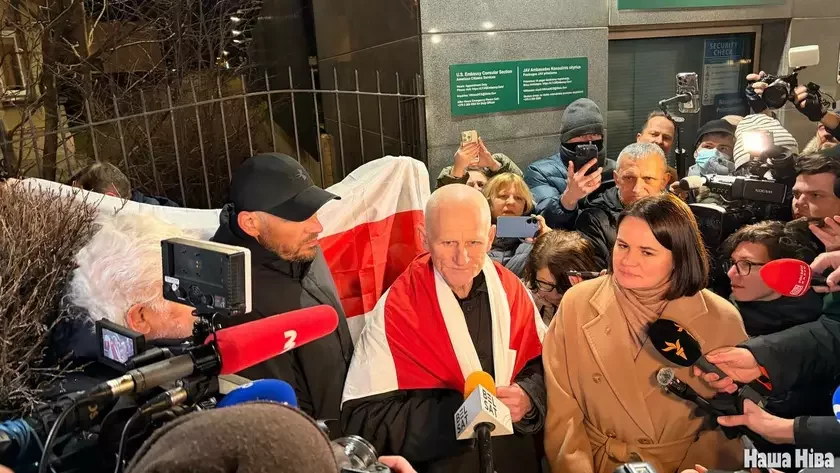
Meeting with Ales Bialiatski. Photo: Nasha Niva
Firstly, bots began to devalue the sacrifices of the imprisoned, asking a rhetorical question:
"What have these people done for Belarus?"

And they themselves offer traditional answers:
"Nothing," "They almost led Belarus to war."
To intensify the degree of hatred, comparisons with garbage and useless things are used:
"They threw out the trash," "They're throwing out all the useless riff-raff," "Used material."

There are also comments where authors seemingly doubt the authorities' decision:
"He released them in vain," "In vain," "I don't know, maybe in vain."

However, the main emphasis is on predicting conflicts. Bots are trying their best to prove that the release of a new group of political prisoners will lead to an exacerbation of disagreements within the democratic forces:
"Tsikhanouskaya is in shock now. How will they all divide power? Poor Sveta," "Sveta is in mourning. She just got rid of Siarozha, and now there's a whole crowd of competitors fighting for European grants. What a disaster!" "Sveta needs to prepare her accounting. The banker has arrived."

Others pick up on this theme, calling political processes a show or a circus:
"New game - who will be president," "And here begins the second season. Siaroha couldn't handle it. There will be new characters," "Now the second season of humor will begin. The whole world will watch. Oh, now they'll start slinging mud at everyone and everything," "Isn't Tsikhanouski enough for you? Decided to gather the whole theater," "New puppets released, we'll laugh soon," "The jester brigade has new recruits. A new series of the freak show is beginning."

Special attention in the "methodology guides" is given to the appearance of the prisoners. Propaganda cynically claims that prison conditions benefited people:
"They look like they just came from a resort," "Everyone looks much better than they did. Well-fed and content."

Bots are particularly rude about specific individuals. Here's what they write regarding the appearance of Maria Kalesnikava:
"Kalesnikava's face barely fit into the lens," "Kalesnikava looked like she had been at a resort."

They also did not overlook Nobel laureate Ales Bialiatski:
"He's younger," "Looks better than before," "What were they feeding him? Like after a sanatorium..."

Against the backdrop of insults to political prisoners, bots actively promote the narrative of the dictator's strength and independence. They strive to prove that in the negotiation process, the final word rests exclusively with Lukashenka:
"Everything is done on Lukashenka's terms!!! Father is strength!!!" "Lukashenka once again showed his nobility and that he fears no one!" "Lukashenka is not afraid of any pressure!! Why keep them in prison? But if you agree, and they seemingly cooperated, then sanctions are lifted for the country," "Father is handsome. The deal is lit," "Lukashenka is simply a handsome man."

Another popular thesis concerns saving money. Propagandists try to convince the audience that the release is a way to get rid of unnecessary expenses:
"He released them so as not to feed 120 people. Get them off the taxpayers' balance sheet," "Let them all be exchanged for fertilizer. There's no need to support parasites," "If these were people, they would have stayed in Belarus."

And, of course, the bots don't forget to once again comment on Sviatlana Tsikhanouskaya, trying to completely negate her role in the process:
"Tsikhanouskaya has no merit here. Americans promised to buy Belarusian potash in exchange for the release of political prisoners," "What does she have to do with it? She didn't impose the sanctions, and did she even meet any of them today?" "In Belarus, Tsikhanouskaya is a nobody."


Comments