


In his first conversation with journalists, Bialiatski shared details of his transit through Belarus with his eyes blindfolded, spoke about his health condition, and thanked everyone who contributed to his release.
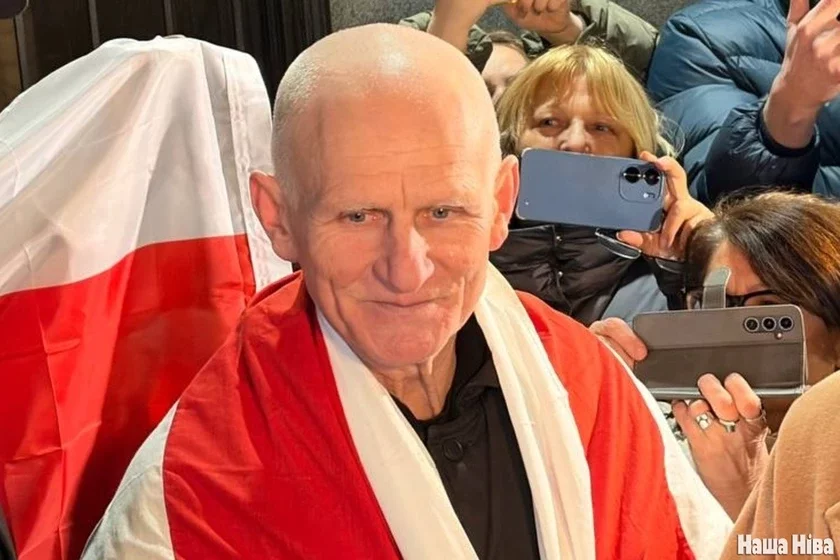
As the Nobel laureate stated near the walls of the American Embassy in Vilnius immediately after his arrival, today at four o'clock in the morning, the duty officer of the squad woke him up.
âAnd when I came out, I was told to urgently pack my things. And I already understood that the release process had begun,â he noted.
When asked if there were any premonitions or prior information, Bialiatski answered affirmatively:
âThere was a premonition. Because after Sergei Tsikhanouski was released in June, and after his release, when 51 political prisoners were released in September, it became clear that this process had begun, and all that remained was to wait and hope that it would not be disrupted. Because we understand that at any moment the situation can change for the worse.
And therefore it is very important for everyone to continue to keep their focus on those political prisoners who are currently in Belarusian prisons, and to achieve the full release of all. So that not a single political prisoner remains there.â
About the Journey and Emotions
Bialiatski also shared his first emotions after his release:
âIn the morning, in the dead of night, I was in prison, lying there, so to speak, in completely different conditions, on bunk beds, in a room where there were almost 40 people. And now I am free. Of course, considering that I spent 4 and a half years in such conditions, in prison, the feeling is still not entirely clear to me. But I think I will get used to it quite quickly and accept the reality â that I am free.â
The human rights defender admitted that he had not fully recovered from the journey yet:
âMy head is still spinning, I haven't fully come to myself. Because just last night I was in completely different conditions, as were all my colleagues who have now been released and are making their way here to Vilnius. (...)
Nevertheless, this journey was undertaken with my eyes blindfolded. I traveled across all of Belarus. I was held in a colony in Horki. This is the MahilioÅ region, very close to the Russian border. It's 14 kilometers to the Russian border from the colony.
I traveled across all of Belarus from east to west with my eyes blindfolded. And naturally, here, I still can't fully come to myself. Because this is a huge emotional blow for me. During this time, I only managed to speak with my wife.â
About the Nobel Prize and Those Who Remain Imprisoned
Bialiatski said that he learned about being awarded the Nobel Prize while in the pre-trial detention center in Valadarka. Journalists asked what this award means to him now.
âIt must be said that this Nobel Prize was awarded not only to me personally, but to all Belarusian activists and to the entire Belarusian people who advocated and advocate for democracy and human rights in Belarus, who continue their struggle. Although it is not easy and difficult for us, through prisons.
Thousands of people have been and continue to be imprisoned. My colleagues, my colleague Valiantsin Stefanovich, a human rights defender, also continues to be imprisoned, despite my release. Therefore, our struggle continues. And the Nobel Prize, I believe, was a certain recognition of our activity, our aspirations, which have not yet achieved their realization.â
About the Situation in the Colony and Health
Ales Bialiatski said that about 20 political prisoners are held in the colony where he served his sentence.
âVirtually in every squad, there is one or two people [political prisoners]. We all tried to maintain contact with each other there and support one another in some way. There are people who have been imprisoned since 2020, since 2021.â
When asked about his health, Bialiatski replied reservedly:
âMy health is more or less fine. Now I will need to undergo all these examinations, because it is clear that medical care in Belarusian prisons is very poor⦠I think everything will be fine.â
Was There a Choice to Stay
When asked if he had a choice to stay or leave, Ales Bialiatski replied with humor:
âWell, the choice was to stay. Considering that my term was 10 years. So, one could have stayed. But in that situation, there wasn't much of a choice. Either stay in prison, or be escorted out of Belarus with eyes blindfolded in this manner.â
Bialiatski noted that he was advised to ask for a pardon, but he did not. He also expressed gratitude to those who contributed to his release:
âI understand that for us to be free, a great deal of work had to be done. We gained freedom thanks to the efforts of many thousands of people, and primarily American diplomats, American officials, who made efforts to ensure our release.â
When asked if he considered it right that the US lifted sanctions from Belarus in exchange for the release of political prisoners, Bialiatski replied that he does not yet know any details of the negotiations that took place.
Now reading


Ihar Losik recounted how he was held in the KGB pre-trial detention center with a former delegate of the All-Belarusian People's Assembly — a police colonel who, while drunk, almost killed his wife


Comments