


Ukraine Covertly Disbanded the International Legion — Foreigners Sent to Assault Units
The General Staff of the Armed Forces of Ukraine decided to transfer foreign volunteers to assault units with the most dangerous tasks, which came as a shock to many legionnaires. Details from Le Monde.
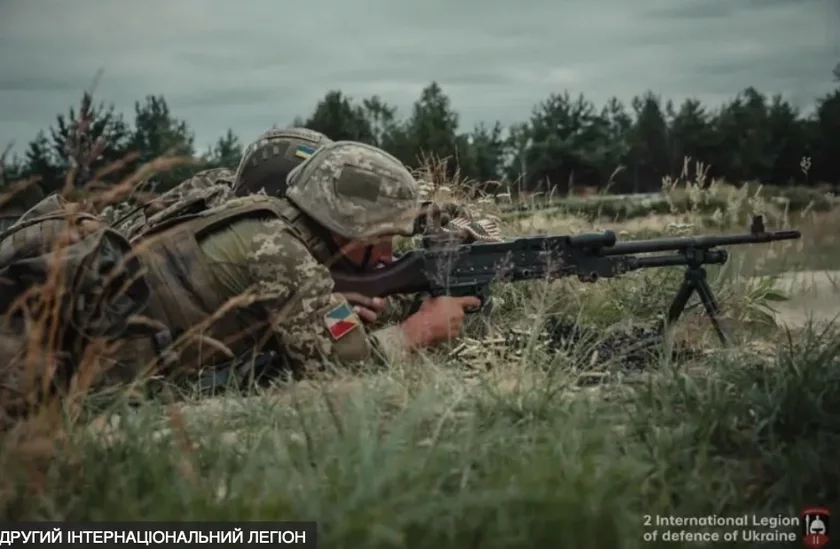
The International Legion for the Territorial Defense of Ukraine was created on February 27, 2022 — a few days after the start of the full-scale Russian invasion. President Volodymyr Zelenskyy's initiative had a clear political and symbolic meaning: to provide foreign volunteers with an official, legal, and understandable mechanism for participating in the defense of Ukraine.
What the International Legion Was
During the Legion's existence, several thousand foreigners signed three-year contracts, although the planned number of 20,000 people in 2022 was never reached.
As part of the Armed Forces of Ukraine, foreigners receive the same financial support as Ukrainian soldiers, but unlike the latter, they have the right to terminate their contract after six months of service.
Since 2022, the International Legion has seen significant rotation of foreign volunteers. At the start of the Russian invasion, Americans, French, British, Italians, Belarusians, and Georgians predominated, whereas today the largest contingent consists of individuals from South America — particularly Colombians.
In 2025, the International Legion consisted of four battalions, each theoretically numbering between 400 and 600 people. It participated in important battles, such as the liberation of the Kharkiv region (particularly the city of Kupyansk in 2022), the summer counteroffensive of 2023 around Bakhmut, and finally, the defense of Vovchansk and Chasiv Yar.
On December 31, 2025, the General Staff and the Ministry of Defense of Ukraine, without widespread public announcement, decided on the de facto dissolution of the International Legion. Its fighters were offered to transfer to assault regiments of the regular army — units that suffer the heaviest losses and perform the most dangerous tasks.
The upcoming transfer of legionnaires was announced as early as November 1, 2025. The Second Battalion of the Legion appealed this decision and secured a postponement until February 15, 2026. However, its fighters have already been transferred to the 253rd Assault Regiment of the 129th Territorial Defense Brigade. Some of the fighters found themselves in Kryvyi Rih without clearly defined tasks, training, or proper conditions, which led to demotivation and the departure of some personnel.
The Chief of Staff of the 2nd Battalion, Lieutenant Colonel Andriy Spivak, called the disbandment of the Legion a strategic mistake. According to him, it was the only structure in the Armed Forces of Ukraine with a fully bilingual officer corps, its own recruitment and training system, and modern tactics based on a combination of about two-thirds drone operators and one-third infantry. He believes that transferring such specialists to assault units means a loss of unique competencies.
According to several sources from the first and third battalions, their ranks significantly thinned in 2025 due to heavy combat losses and, primarily, voluntary dismissals. About a hundred legionnaires remaining in these two battalions joined the 475th Assault Regiment of the 92nd Brigade or other units from November 2025 — depending on their abilities and personal connections.
The Second Battalion managed to retain 70% of its personnel, which explains its reluctance to transfer to another unit. The fate of the Fourth Battalion, which functioned as a training and recruitment center, is not reported by the publication.
What Do the Legionnaires Say?
The reaction of the legionnaires themselves, interviewed by the publication's journalists, to the battalion's dissolution varies. 27-year-old American "Connor," who was born in Ukraine and adopted by a US family as a child, emphasizes that for him, the main thing is to continue fighting for the country, provided his reconnaissance skills are used appropriately.
Others, like Danish volunteer "Viking," primarily perceived the International Legion as a safe and understandable environment for foreigners — with English-speaking commanders and consideration for cultural peculiarities.
Karl, a 53-year-old American combat medic, does not rule out terminating his contract if the battalion is definitively disbanded. He openly expresses disappointment with the higher command. The American had one year left to obtain Ukrainian citizenship after completing his three-year contract, but due to the transfer, this term is effectively nullified, and the count starts anew.


Comments