


The West should reconsider its strategy regarding Belarus — otherwise pro-Russian sentiment will grow
Fresh data from Chatham House surveys indicate a certain increase in pro-Russian sentiment within Belarusian society. Nashaniva journalist Danila Lutskievich predicted such a development as early as late 2023 in his article "By closing itself off from Belarusians, the West involuntarily pushes them towards Russia." The author reflects on why this prediction materialized and what steps should be taken to reverse the trend.

Illustrative photo. Photo: BelTA
How sentiments are changing
The latest Chatham House survey shows an increase in the percentage of those in Belarus who support an alliance with Russia on foreign policy issues. 44% of respondents expressed this view this year in August-November. For comparison, in September 2020, this figure was only 27%. Notably, the share of those sympathetic to Russia in foreign policy matters primarily increased due to a reduction in the proportion of those who previously advocated for a simultaneous alliance with both the Russian Federation and the EU, falling from 41% to 22%.
The share of European Union supporters during this period increased from 9% to 15%.
One can, and probably should, approach the results of Chatham House surveys with a certain degree of skepticism, but to deny the trend would be to deceive oneself, especially since similar trends are indicated by the results of iSANS sociological monitoring.
For the trend to stop, the West needs to change its strategy regarding Belarus — or, to be more precise, regarding Belarusian society.
There is no sense in trying to win Lukashenka over. Apart from the fact that Lukashenka has long not been in a position to even pursue a multi-vector policy, he is, by his very nature, a Soviet and pro-Russian man, so his orientation towards the Kremlin is an absolutely natural phenomenon for him.

Lukashenka and Putin. Photo: Ramil Sitdikov Pool Photo via AP
Therefore, the West should more clearly separate Lukashenka's regime from Belarusian society. Especially since 2020 clearly showed that the regime and society can develop in different directions.
The current changes in foreign policy sympathies are entirely predictable. I wrote about how, by closing itself off from Belarusians, the West involuntarily pushes them towards Russia, in November 2023.
And it would be very, very strange if the opposite were happening.
Why is this happening?
Broadly speaking, Belarus has become maximally isolated from the West in general, and the European Union in particular, in recent years.
Indeed, the European Union does a lot for Belarusian civil society. The EU allocated 30 million euros for 2026 to support the Belarusian people (the same amount was allocated for 2025). These funds will go to financially support human rights defenders, former political prisoners, media, and other civil society structures. However, this is not enough to influence people inside the country.
It is very difficult to leave Belarus for the EU, and until the recent opening of two border crossings by Poland, the situation with exiting the country only worsened (the Chatham House survey was conducted in August-November, while Bobrowniki and Kuźnica were opened only on November 17).
Nevertheless, obtaining a visa is still difficult and expensive, so without changes in visa policy, Europe's accessibility will remain low.
And this is not only about tourism, but also about work, education, and the opportunity to see relatives who cannot, or simply fear, traveling to Belarus.

Vilnius. Photo: Nasha Niva
In turn, the opportunity to see with one's own eyes how "the West is decaying and freezing," as Belarusian and Russian propaganda claims, has always been the best antidote to the influence of propaganda.
What is the West doing wrong?
At the same time, unfortunately, measures have often been, and continue to be, taken in the West against Belarusians that amount to a gift to the regimes of Putin and Lukashenka.
When some countries prohibit cars with Belarusian license plates from entering, and reduce bus routes, propaganda doesn't need to lie by saying that no one is waiting for you in Europe and you are not needed there.
Some of the sanctions that continue to appear also primarily hit ordinary people, not Lukashenka's regime, as he certainly won't be traveling to the European Union for household chemicals or a new laptop.
These and some other restrictions are difficult for Belarusian society to understand — why it's not possible to buy washing powder in Poland or Lithuania and then, after arranging tax-free, travel back.
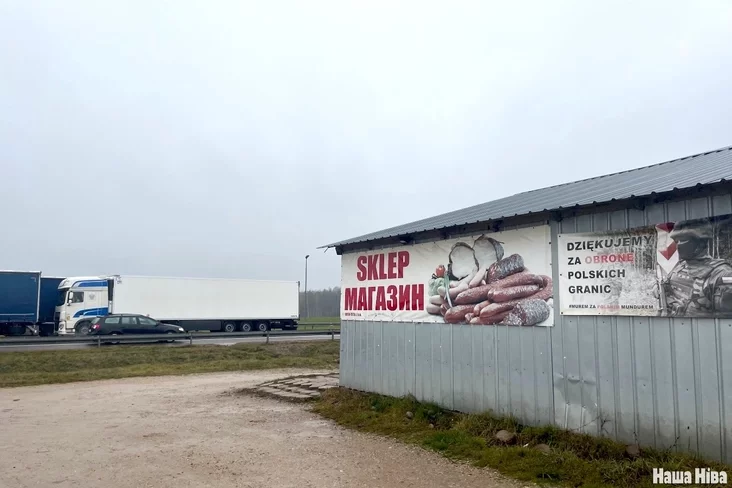
Polish border crossing Bobrowniki (Brestovitsa on the Belarusian side). Photo: Nasha Niva
It's probably difficult for an ordinary Belarusian to understand why they cannot import a hypothetical 2021 BMW 5-Series with a 2-liter engine and pay a reduced customs duty of 2700 euros, but can import a 2019 BMW 5-Series and pay 4800 euros in duty instead of 2700.
Blocking Belarusians' accounts in European banks, additional difficulties with legalization… All these measures do not hit Lukashenka's loyalists — they don't open accounts in Europe anyway. They hit people who are trying to have a fallback option in the EU and clearly do not contribute to growing sympathies for Europe.
The very idea of defaulting to equating Lukashenka's regime with Belarusians is offensive to many, especially considering the context of the mass protests of 2020 and the subsequent repression, which has not ceased for the sixth year in a row.

Protests in 2020. Photo: LookByMedia
Between the protests, which the whole world spoke about, the widespread support for Belarusians, and the start of Russia's full-scale war against Ukraine, where Belarus unwillingly became an accomplice to the aggression, just over a year passed.
As a result, Belarusians, from being "cool people" whom everyone supported just yesterday, became undesirable individuals and are, in a sense, perceived as an enemy to be punished for the actions of a regime they did not choose and did not support.
This could also have served as a certain trigger for a part of society and even caused resentment. Especially if these were more neutrals than overtly pro-European people.
And all of this is happening against the backdrop of a total media crackdown and the efforts of Lukashenka's and Russian propaganda.
What can be done?
If the European Union wants to have a country on its eastern borders whose population has a positive attitude towards the EU and wants to have good relations with its Western neighbors, then the strategy of relations should be reconsidered. Belarusians should feel that the West is not against them, that it is ready to help them avoid falling completely into the hands of the Kremlin. It is beneficial for Belarusians to see firsthand how the free world lives without immutable dictators in power.
Such support for Belarusians is in Europe's own interest, because it's better to have a dictatorship nearby with a population that views you positively than a dictatorship where the people are embittered towards the West and genuinely see it as an enemy and a threat.
And such sentiments cannot develop when an ordinary Belarusian sees nothing but prohibitions and restrictions from the West.
In turn, the very fact of maximal isolation of Belarusians from Europe is exactly what Lukashenka needs. He himself does not hide that he opposes Belarusians traveling there to study and work, as they return from there with "brainwashed minds".

Alexander Lukashenka. Photo: Getty Images
Lukashenka has purged all independent media and NGOs within the country. The regime understood that a free society would not want to live under a dictatorship, so the people must be maximally separated from the West and the values of law and freedom.
It is time for the West to reconsider its policy towards ordinary citizens of Belarus, so that they can see and feel positive signals.


Comments