


Concreting Money — a National Idea for Belarusians? We Compared Construction Rates in Belarus, Poland, Lithuania, and Latvia
We looked at how the construction of new housing in Belarus compares to its EU neighbors. Spoiler: the difference is surprising.

Minsk World Residential Complex. Developer's photo
Did Mass Emigration Affect Construction Volumes?
Over the past five years, 47-52 thousand new apartments are put into operation annually in Belarus. (In statistics, 'apartments' include both apartments in multi-story buildings and single-family houses).
This is about 51-56 new apartments per 10 thousand inhabitants. This is quite a lot, but still far from record figures.
However, if we look at 2019, which can be called the last stable year (as it was followed by the pandemic and mass emigration), we will see that construction volumes then were even slightly lower than in subsequent years — 46.9 thousand apartments.
The peak period was from 2009 to 2011 and later — 2014. In these years, much more was built than afterwards. For instance, in the record year of 2010, 84.5 thousand apartments were commissioned in Belarus, in 2009 and 2011 nearly 70 thousand apartments were built, and in 2014 — about 72 thousand.
But to understand whether a lot of housing is being built in Belarus or not, one needs to look at the number of constructed apartments relative to the population and compare these data with other countries in the region.
In terms of population, in 2009, 2011, and 2014, 73-74 apartments were built per 10 thousand people annually, and in the peak year of 2010 — as many as 89 apartments.
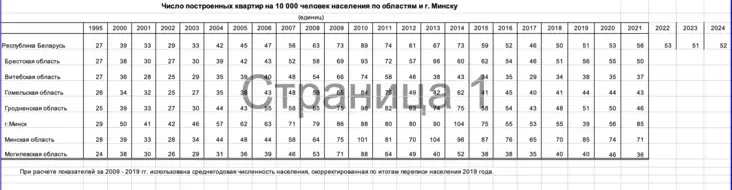
Number of apartments built per 10,000 population. Up to and including 2021 – Belstat data. 2022-2024 – Nasha Niva's calculation based on other Belstat data.
It turns out that over the past twenty years, an average of 58 apartments per 10 thousand population were built annually in Belarus.
For comparison, let's take three neighboring European countries: Poland, Lithuania, and Latvia.
Poland
In Poland, over 200 thousand apartments have been built annually since 2019. 2022 was the peak year, when over 238 thousand apartments were commissioned within a year. This is almost 63 apartments per 10 thousand inhabitants (in Belarus, as of 2022, it was 53 apartments per 10 thousand people). In 2024, construction volumes in Poland decreased to 200 thousand apartments, or 53 apartments per 10 thousand people (in Belarus in 2024, this figure is 52 apartments).
Looking at the figures for the last twenty years, an average of approximately 45 new apartments (residential units) per 10 thousand population appeared annually in Poland, which is significantly less than Belarus's 58 apartments.
Lithuania
Lithuania has experienced a construction boom in the last three years.
In 2024, 14,587 new apartments were built there (as with Belarus, 'apartments' include single-family houses). In 2023 — 15,427 apartments, and the peak, as in Poland, was 2022 with almost 17 thousand new apartments.
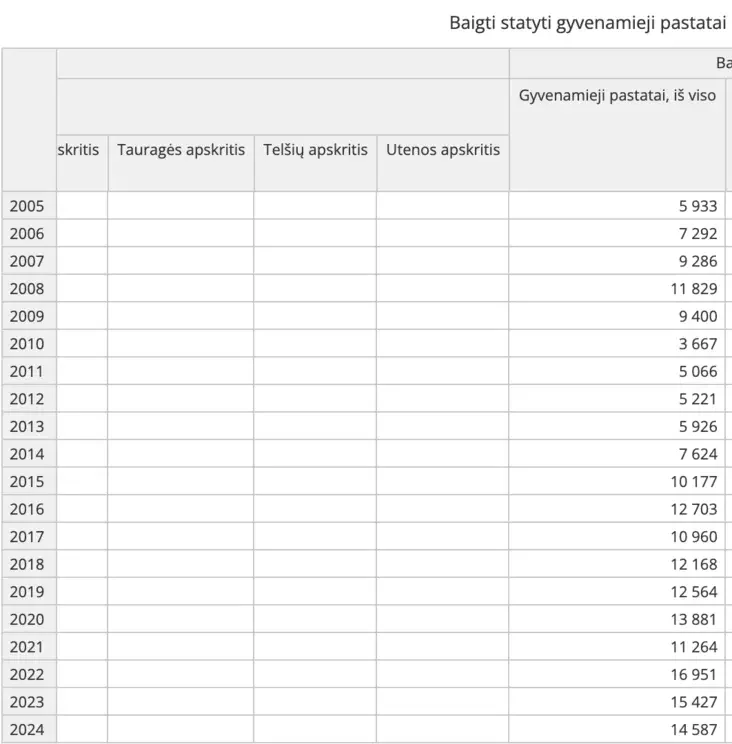
Data on the number of housing units commissioned in Lithuania from 2005 to 2024. Screenshot: stat.gov.lt
In terms of population, in 2022, Lithuania had 60 apartments per 10 thousand people, which is more than in Belarus (53).
However, if we take a longer period, it turns out that new housing has been built much more actively in Belarus over the past twenty years than in Lithuania.
While in Lithuania, an average of 34 new apartments per 10 thousand population appeared annually over the past twenty years, in Belarus it was 58.
Latvia
This neighboring country significantly lags behind not only Belarus but also Poland and Lithuania in terms of construction rates.
Peak indicators for new housing construction in Latvia occurred during the period from 2006 to 2008.
After this, construction volumes in Latvia remained consistently low. Taking the period from 2010 to 2024, an average of only 14.3 apartments per 10 thousand population were built annually in Latvia.
However, since we are considering a twenty-year period, the figures are slightly higher due to the high construction rates in the second half of the 2000s.
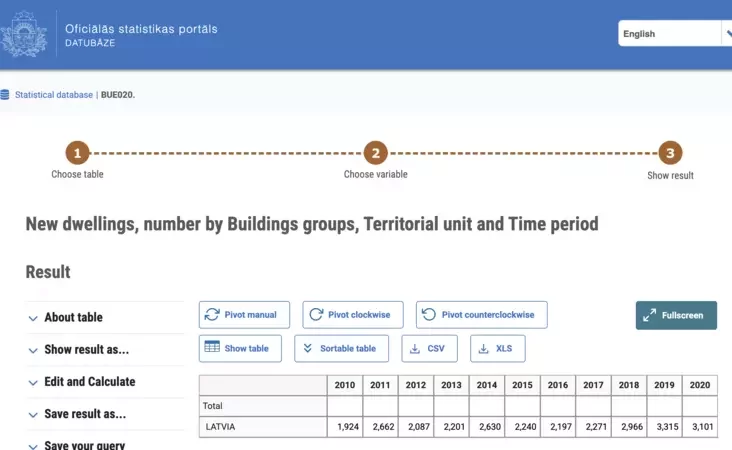
Number of new apartments (residential units) commissioned in Latvia from 2010 to 2020. Screenshot: stat.gov.lv
It turns out that in Latvia, an average of approximately 20 new apartments per 10 thousand population appeared annually over the past twenty years. For comparison: in Belarus — 58, in Poland — 45, in Lithuania — 34.
Other data also indicate that very little is being built in Latvia. For example, according to official statistics, as of 2021, only 7.6% of all housing units in Latvia were built between 2000 and 2020.
Belarusians Love Concreting Money
Belarus, with its 58 apartments per year per 10 thousand population (over the last twenty years), is the absolute leader in this ranking. However, in Poland and Lithuania, slightly more new housing has been built in recent years than in Belarus.
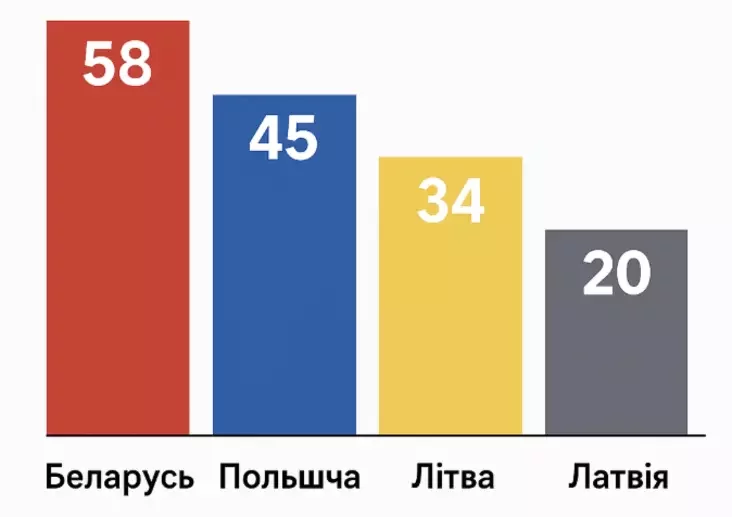
Average number of new apartments (residential units) built per year in Belarus, Poland, Lithuania, and Latvia over the last 20 years per 10 thousand population.
When comparing the data with the three neighboring countries, a logical question arises: why is so much housing being built in Belarus?
One of the important factors could be a psychological one.
Owning real estate is exceptionally important for many Belarusians. Many deny themselves everything for years and even decades, getting into debt and taking out loans to buy an apartment or build a house.
In addition, investing spare money in real estate remains popular in Belarus.
A very popular belief has emerged among the people that investing in real estate is the best way to save money.
However, upon a deeper dive into this topic, it turns out that this is not entirely true, as real estate prices in Belarus are unstable. A square meter in Minsk (and beyond) currently costs roughly as much as it did at the two previous peaks, which occurred in late 2007 — early 2008 and late 2013.

Illustrative photo: Nasha Niva
And these are raw figures without considering inflation, which devalues money annually. For example, accounting for inflation, to simply not lose anything on an apartment bought in 2009 for $100 thousand, it would now need to be sold for approximately $140 thousand.
But, for example, those who bought housing before the price increase in recent years can indeed sell it more profitably now.
Some Apartments Stand Empty for Ten Years or More
Because people in Belarus love concreting money, an interesting picture can be observed: many unfinished apartments are for sale in buildings commissioned 5, 10, and even 15 years ago.
For example, in the 'Realt' database alone, there are more than 60 apartments with bare walls in buildings constructed between 2010 and 2020.
Among them is a three-room apartment at Filimonova, 55; the building was constructed back in 2016.

Screenshot: advertisement on realt.by
But there are also older apartments without renovation. The Tchaikovsky Residential Complex was built in 2014, but there is still an unrenovated apartment there that is currently for sale.
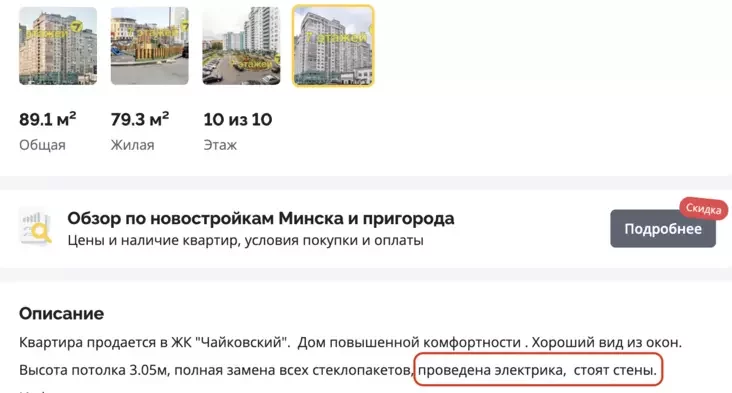
Screenshot: advertisement on realt.by
Many unfinished apartments are for sale in Minsk World. Some owners of such apartments even try to rent them out, including for storage purposes.
And these are only the apartments that are for sale and marked as 'unfinished'. The total number of apartments in Belarus that stand for years without renovation and residents is unknown, but such apartments exist not only in Minsk.
Another category of vacant apartments is housing built with preferential loans. These are cases where people only had a 'paper need' for improved living conditions. They do not live in these apartments, nor can they rent them out, as this is prohibited by law. Therefore, such apartments also stand vacant for years.
«Nasha Niva» — the bastion of Belarus
SUPPORT US-
A 'square meter' costs $2750. This is not a luxury, but the cheapest apartment in Minsk
-
There's a table, burners, a bathtub, and a toilet — what else do you need for happiness for $280? A "joke" that became a reality in Minsk
-
How Fanipol's "birdhouses" overcame hate: 18 sq. m micro-studios sold out in a week


Comments