


The Philippine People Power Revolution became possible thanks to the dedication of Corazon Aquino, the widow of the opposition leader, and the support of the army. But the prerequisite was pressure from the foreign sponsor of the dictatorship.

The Republic of the Philippines, the only country in Asia with a predominantly Christian population, also went through a period of dictatorship. Currently, many Southeast Asian countries are developing as democracies. But at the turn of the 70s and 80s of the 20th century, there were almost no democratic countries in this region, except for the most developed one, Japan.
The Return of the Emigrant
In 1983, the leader of the Philippine opposition, former senator and head of the Liberal Party, Benigno Aquino, returned to his homeland from exile in the United States. The authorities warned Aquino that if he returned, he would be arrested right at the airport and sent to prison to serve out his term.
Three years earlier, Aquino had been released on humanitarian grounds and allowed to go to the United States to recover from a heart attack he had suffered in prison. There he stayed, giving lectures and gathering the diaspora.
Aquino was a seasoned political fighter. Before emigrating, he spent 8 years in prison, received a death sentence, and did not break... These were cruel times, even more cruel than now.
Aquino decided it was time to return. He was bored in exile, and the dictatorship was clearly on its last legs: both the economy and society were faltering.
At that time, dictator Ferdinand Marcos had ruled the Philippines for 18 years.
In 1965, when Marcos came to power democratically, the Philippine economy grew rapidly. But the social sphere lagged behind, and the new president promised to change that. In his first term, he made education and medicine more accessible and started a large road construction project to connect the main islands of the Philippine archipelago, which number 7,641.
As a result, Marcos became the first president in the country's history to be re-elected for a second term. But then it became difficult: he took out many loans, and the economy was on the brink of collapse, relying only on foreign support: money from the International Monetary Fund and the United States.
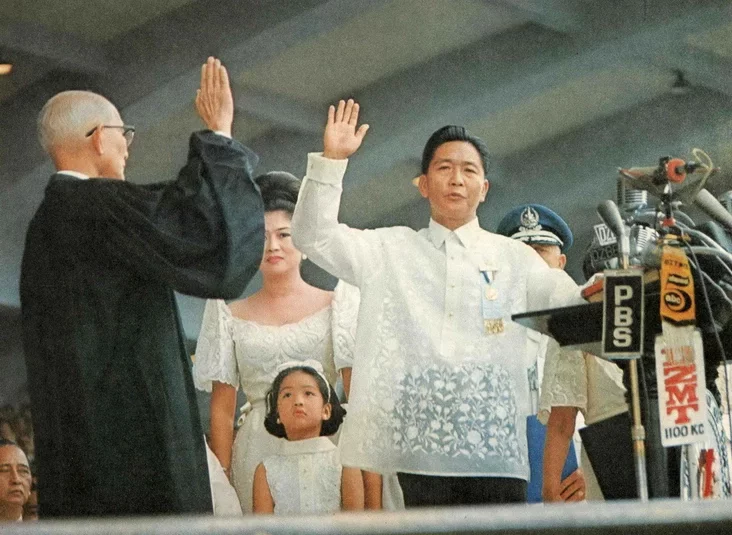
Mass protests against inflation, cuts in social programs, and dictatorial antics began in 1970. To stop them, Marcos declared martial law in September 1972. Aquino was also imprisoned then. Martial law lasted for eight years. During this time, the country's external debt increased by a factor of 11.
"The Generals Decided Themselves"
A thousand special forces and Internal Troops soldiers were waiting for Senator Aquino at the airport to arrest him. But Aquino did not end up in prison. As soon as he was led onto the plane's ramp, shots rang out. First one, then bursts. Airport, Asia, a human hive, it would seem, but no one else, neither the reporters accompanying Aquino on the flight from Taipei nor the airport staff, saw who specifically shot Aquino in the back of the head, as if carrying out a death sentence.
The official version was that Aquino was shot by his own, an opposition member, but a radical, a communist, who was hiding under the ramp. This opposition member was immediately riddled with bullets from automatic weapons by the soldiers, who fired at him for several minutes.
Later, there would be an investigation, and it would reveal that it was not an opposition member, not a radical, of course, but the security forces themselves, a large group of them, who organized Aquino's murder. They, including generals, would go to prison for 22 years, and this would happen even under Marcos's rule. The dictator was allegedly not involved at all, he was sick at the time.
There is still no proof that Marcos gave the order. Maybe he didn't give the order. The generals decided themselves.
How Did She Stay Alive?
For all nine days that people said goodbye to Senator Aquino, he lay in his coffin unadorned, with an uncovered bullet hole in his head. It was his mother's will: "Let everyone see what they did to my son!"
Corazon Aquino, the widow of Senator Benigno, and their five children flew in for the funeral from the United States. Two million people gathered to say goodbye, many with yellow ribbons, a symbol of remembrance. From this funeral, from this procession behind the coffin, Corazon Aquino's popularity began, Corazon meaning "heart" in Spanish.
Corazon would stay in her homeland.
The ship of dictatorship continued its voyage, but the breaches were becoming more and more numerous.
In the summer of 1985, two years after Aquino's assassination, American journalists discovered that Marcos and his wife Imelda owned expensive real estate in the United States. There was a scandal. In parallel, it was revealed that the Philippine dictator had lied about his heroism during World War II, and his father had collaborated with the Japanese occupiers.
In such circumstances, Corazon Aquino put forward her candidacy for the early elections of 1986.
Corazon Aquino did not participate in politics, but she was immersed in it. She grew up in the family of a politician, a wealthy landowner, and for a long time lived with the concerns and anxieties of her husband.
State media ridiculed her as a housewife with no management experience. But her speeches became more and more meaningful, and her voice became confident. She stood out favorably from other opposition leaders, each of whom tried to pull the blanket over themselves.
Why wasn't she killed too? There is a hypothesis that Marcos was strictly warned against this by the Americans, the regime's sponsors, whose opinion the dictator could not ignore. For the United States, both Benigno and Corazon Aquino were an acceptable opposition, a guarantee that in the event of a change of power, the country would not be taken over by supporters of the USSR, as the Cold War was underway then.
Voter turnout in the elections was high, at 79% of voters. Officially, this is less than in the 1981 elections. But observers noted that visually there were more people at the polling stations than in previous years.
Officers of Three Graduating Classes
1986. On February 15, the Central Election Commission declared Marcos the winner. In response, Corazon gathered a large rally. Hundreds of thousands of Filipinos took to Manila's analogue of the Minsk second ring, Epifanio de los Santos Avenue (abbreviated EDSA, which is why the events are sometimes called the "EDSA revolution"). Aquino's plan included completely peaceful calls: not to pay taxes and utility bills, not to buy goods from companies associated with the dictator.
The Catholic Church, which is very respected in the Philippines, sided with Aquino. Cardinal Ricardo Vidal called the election results "unfair." He said that every Filipino should decide for themselves what to do next. And he added that the Church had already made its decision: it would fight against lies.
Who knows if Marcos could have been overthrown in such a "long way." But everything went differently. At the time of the elections, there was a group of young officers in the army who did not accept the realities of the dictatorship and were thinking about a decisive method of change. They had a plan to storm the presidential palace. The young officers called themselves the "Armed Forces Reform Movement," which resembled the Portuguese "Captains' Movement." It was a small circle of friends: officers from three graduating classes of the Military Academy united in these groups, at the time of the elections they were 37, 36, and 30 years old. But they were informally assisted, with all the general's cunning, by the Minister of Defense.
The turning point of the Yellow Revolution was the unexpected statement of 32 technical employees, computer administrators of the Central Election Commission of the Philippines. They stated live on the air that the elections had actually been blatantly rigged. Linda Kapunan, the wife of one of the young "reform officers," instigated them to do so.
Marcos still managed to arrest some of the officers-conspirators. But on February 22, the head of the Internal Troops, Fidel Ramos, and the Minister of Defense, Juan Enrile, also stated that they believed the evidence of election fraud and considered Corazon Aquino the winner.
Two Inaugurations
Other security forces at that time continued to remain loyal to Marcos. Everything was still shaky. When a column of armored vehicles left the base, thousands of people were able to stop it with a human shield, with nuns with rosaries in the front row.
Army units did not want to get their hands dirty dispersing people and began to swear allegiance to Corazon one after another. Or to Generals Ramos and Enrile, which meant the same thing. An attempt to send helicopters to the dissatisfied ended in failure: the crews went over to Aquino's side, returned to the base, and attacked the airfield where the aviation loyal to Marcos remained.
To a large extent, Marcos himself pushed the military to betray him when, due to his own suspiciousness, he destroyed the social elevators in the army. Of the 60 generals, 27 were pensioners by age. But the dictator forbade them to retire, as they were loyal to him, and he did not trust the younger, less vetted ones. Colonels, however, practically having no chance of career growth with such a dictator's policy, went over to the side of Corazon Aquino.
Marcos forbade firing live ammunition at the demonstrators, as Washington said that crossing this line would have consequences. Nevertheless, in the moment of chaos on February 25, snipers still opened fire on people.
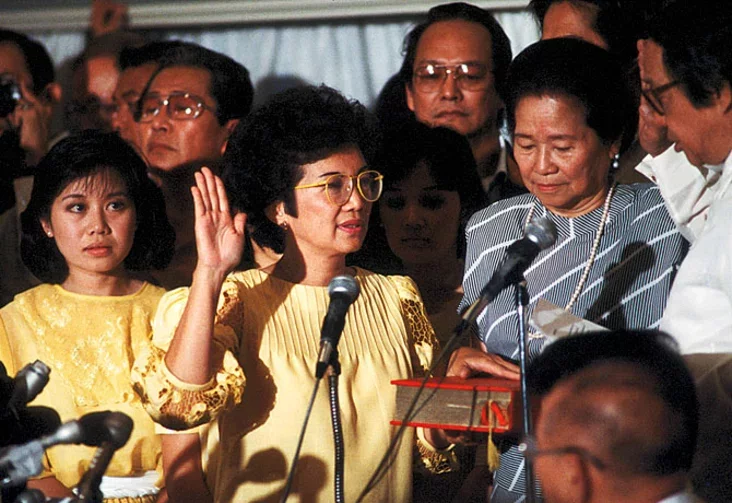
Two inaugurations took place on February 25, 1986. First, Aquino took the oath in the elite "Philippina" club. After that, Marcos did the same in the presidential palace. But this was already just acting. At that time, approximately 90% of the military had gone over to Aquino's side.
On February 26, Marcos and his family were already at an American military base in Hawaii. And millions of Filipinos took to the streets of the cities to celebrate the end of the dictatorship.
Corazon Aquino Did Not Run for a Second Term
A year later, a new constitution would be adopted in a referendum.
A year before the end of her presidential term, Aquino would achieve the withdrawal of US troops from the Philippines.
Aquino refused to run for a second term, although she could have taken advantage of the adoption of the new constitution. Instead, she supported the candidacy of the one without whom she would not have won in 1986, General Fidel Ramos.
She did not participate in politics further, but as a moral authority, she spoke out about events and helped her son, Benigno III (the first was his grandfather, also a politician), become a senator. By the way, Benigno Aquino would later become the president of the Philippines as well, and would be so from 2010 to 2016.
-
A whole necropolis was accidentally discovered in the center of Grodno. There could have been a temple known since the 15th century
-
Harasyim Ihnatavich from Vitsebsk turned out to be an armored boyar. A historian told about his fate
-
Near Vitebsk, a water pipeline was being dug, and a 400-year-old stone cross of Harasim Ihnatavich was found


Comments