


Last Belarusian Voices. Belarusian Language Completely Died Out in Latgale
Latgale — the eastern region of Latvia — has always been a unique cultural crossroads. Here, among blue lakes and Catholic churches, the "simple language" — an authentic Belarusian dialect — resonated for centuries. However, today scientists are forced to state: the Belarusian dialect in Latvia is rapidly fading into oblivion, remaining only in archival records.
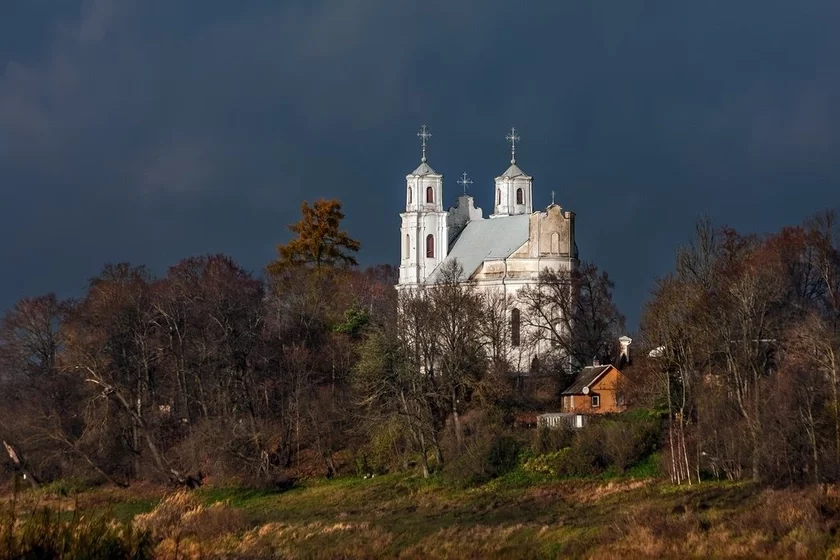
View of the Pidruja Church from the Belarusian side of Druya. Photo: Yandex Maps
From the Times of the Krivichs
The history of Belarusian presence in Latgale begins long before the emergence of modern borders. Already in the 5th-8th centuries, these lands began to be settled by the Krivichs. The depth of these ties is evidenced by the Latvian ethnonym "krievs" (Russian), which originally referred specifically to the Krivichs.
During the Polotsk Principality, the Daugava (Dvina) was the main trade artery, and Polotsk had great political and cultural influence here. Later, over centuries, these lands were part of the Grand Duchy of Lithuania and the Polish-Lithuanian Commonwealth, where the Slavic element remained dominant in many volosts (districts).
During the Russian Empire, there was no administrative border between the lands of Latgale and modern Belarus, which facilitated the free movement of the population, and common economic and cultural life. Dzvinsk (Daugavpils), Liutsyn (Ludza), and Rezhitsa (Rēzekne) were district towns of the Vitebsk Governorate. According to the 1897 census, Belarusians constituted a significant part of the population of these districts, and in some volosts — an absolute majority.
Belarusian Latgale: From Karski to Modern Research
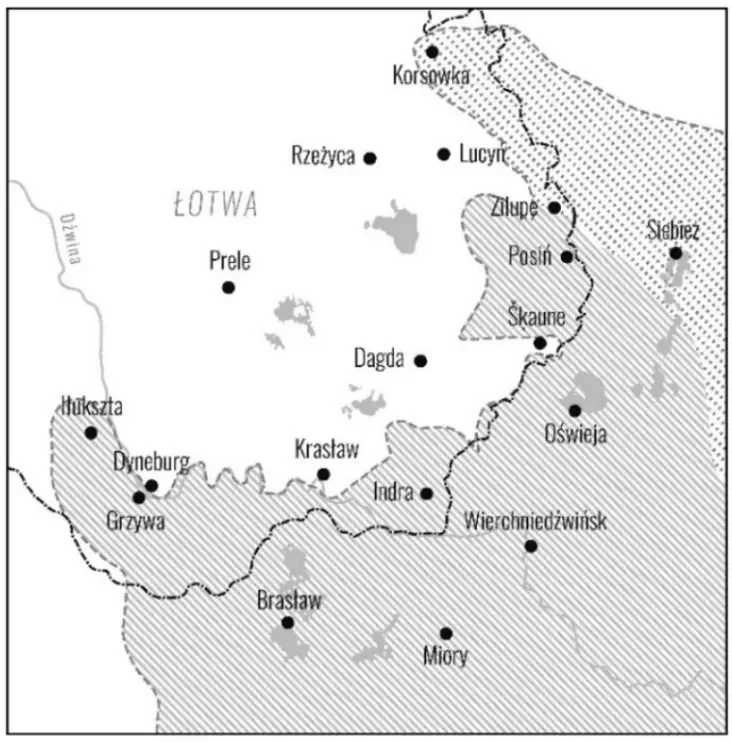
Belarusian language on the territory of modern Latvia in 1903. According to the ethnographic map of Belarusian dialects by Yaukhim Karski. Hatching indicates dialects with strong akanye (vowel reduction) and hard [r], dots indicate dialects with soft [r']. Map from Yankovyak's work.
The history of documenting the Belarusian language in this region began in 1903 with a large-scale expedition by academician Yaukhim Karski. At that time, he outlined the boundaries of the spread of Belarusian dialects much further north than the modern state border. Karski noted that the local population preserved classic features of Belarusian phonetics: dzianne, tsianne, fricative [h] and hard [r]. Karski drew the boundaries of Belarusian dialects far beyond the Daugava, including Ilūkste and even the town of Korsava (Kārsava) in the north. A century later, the picture has changed dramatically.
In the latest issue of the scientific journal Acta Albaruthenica (2024), a study by Polish linguist Mirosław Jankowiak, who followed Karski's paths from 2004 to 2019, was published. The conclusions of his many years of fieldwork sound like an epitaph to a vanished language.
North and West: Complete Assimilation
According to Mirosław Jankowiak's data, the greatest losses occurred in the northern part of the historical area. The vicinity of the town of Korsava (Kārsava), where Belarusian dialects were still recorded at the beginning of the 20th century, is now completely Russified. The local Slavic population has switched to Russian, and finding speakers of the Belarusian dialect there is no longer possible.
A similar situation is observed in Ilūkste district (left bank of the Daugava). This region always had a strong Polish influence, and in Soviet times, Russian dominated here. Even post-war settlers from Braslaŭ region could not influence the linguistic landscape and quickly assimilated. Today, the Belarusian dialect is practically not found here.
Dagda and Zilupe Districts: Migrants Without Roots and Mixing with Russian
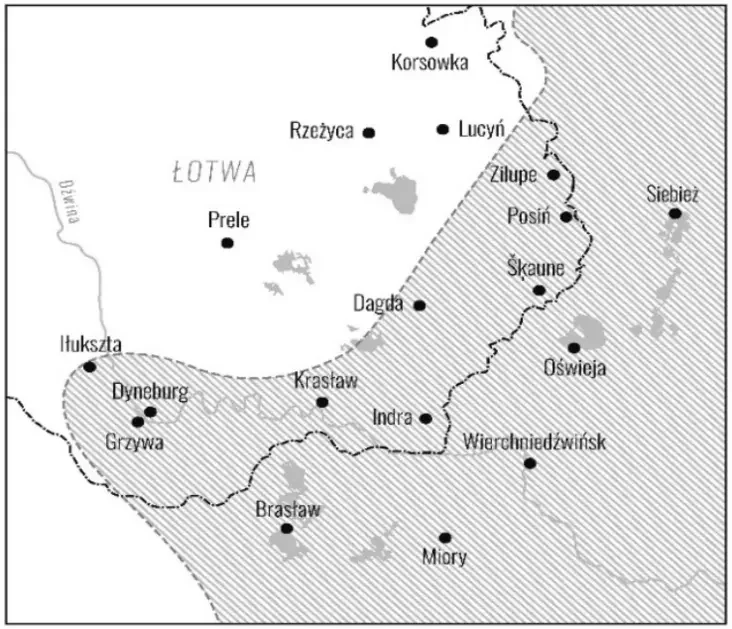
Belarusian language on the territory of modern Latvia in 1914. According to the map of the Moscow Dialectological Commission. Map from Yankovyak's work
In Dagda district, which is historically Latvian (Latgalian), the Belarusian language appeared predominantly after 1945 along with labor migrants who came to Soviet collective farms.
Lacking deep roots, this language is rapidly disappearing.
Today, its remnants are recorded only in the very eastern corner of the district, near the village of Asūne.
In the borderland Zilupe district, the situation is more complex. In the villages of Harani, Pasiene, and Šuškava, the local dialect can still be heard. However, it has been heavily transformed under the influence of the Russian language, which dominates the region. Scientists characterize the current state of the local dialect as transitional or mixed type.
Krāslava District: Decline of the Traditional Center
Krāslava district remained the most stable region for the existence of the Belarusian language in Latvia for a long time. Villages south of the town — Indra, Pidruja, Vaivadi — preserved the language longer than others. A peculiarity of this region was the so-called "simple language," which was used even by those residents who identified their nationality as Polish.
However, now a rapid process of linguistic shift is taking place here too. The Russian language plays the role of a prestigious means of communication, displacing dialects from daily use. The younger and middle generations no longer adopt the language of their ancestors.
Reasons for Disappearance
Scientists highlight the main factor in the disappearance of Belarusian dialects — demographic decline.
Active speakers of the authentic dialect are people born in the 1920s-1940s. The generation of the 1950s is already predominantly Russian-speaking, retaining only individual phonetic features (accent).
The situation is worsened by the lack of institutional support: the Belarusian language in the region is not used either in school education or in the religious life of churches.
The absence of new population inflow from Belarus also makes the process irreversible.
While in the early 20th century Karski wrote about tens of thousands of speakers, modern estimates of the number of people who speak a pure dialectal Belarusian language in Latvia are measured in dozens.
In fact, the dialects cease to be a means of living communication and transition into the category of dead objects that can only be studied through archival records.
«Nasha Niva» — the bastion of Belarus
SUPPORT US


Comments