


"They're following Babariko's path": Nikita Monich responded to Rodion Kolos' criticism of the Maldzis initiative.
Art critic Nikita Monich has released a video in which he comments on the activities of the Maldzis initiative and the discussion that has flared up around it.
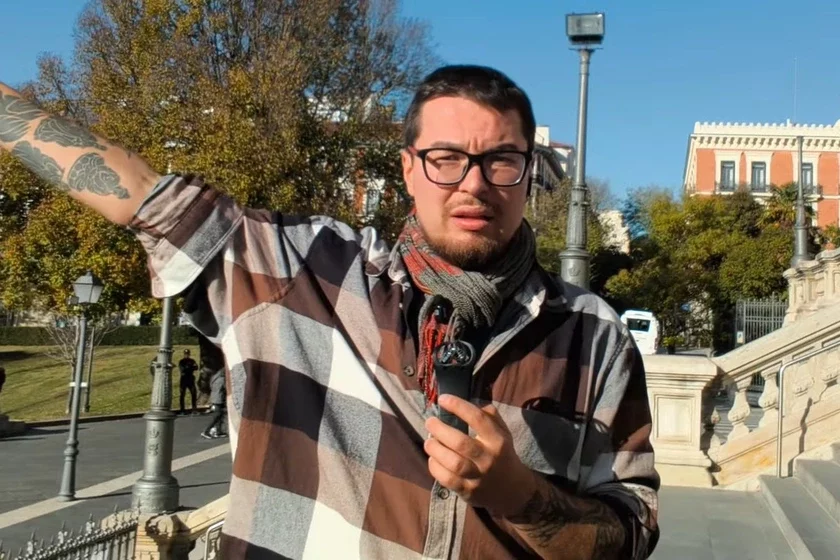
Nikita Monich suggests looking at the situation more broadly and highlights three main thoughts on the state of Belarusian culture.
Three theses on heritage
Firstly, the art critic reminds us that heritage is only what has been preserved, and it is always a smaller part of what was created.
"Time is merciless: fires, floods, political repressions, religious propaganda, and wars feed on cultural products with the same pleasure and appetite as human flesh," he notes.
Secondly, a significant part of the Belarusian heritage is located outside the country, and this is an objective reality.
As Monich notes, artifacts are scattered in museums and collections in Moscow and St. Petersburg, Warsaw, Vilnius, Kharkiv, the Metropolitan Museum in New York, and others.
This is not an exception, but "a given that our society began to work with as the Belarusian state was being built, and, in general, will be forced to continue."
Thirdly, the main task of museums and archives is physical preservation, as the history of Belarus is full of catastrophic losses.
During the Second World War, entire collections were destroyed or disappeared: some did not have time to be taken out, some were taken out and lost, some were not returned after the war, some were returned, but to other museums in the USSR. Soviet cultural policy often treated pre-Soviet, aristocratic, bourgeois, religious, and national art as unnecessary.
Monich gives a number of specific examples:
— in Vitebsk there were fragments of medieval frescoes from the Annunciation Church, which was blown up in 1961;
— in Minsk in 1965, the Cold Synagogue, the oldest building in the city at that time, was destroyed, and its traces remained in a painting by Mai Dantsig;
— Marc Chagall offered his works to the BSSR in the 1970s, but was refused;
— Aladova bought several paintings by Israel Basov, but the then retrograde Union of Artists "almost tore the museum to pieces," and after that Basov was not bought;
— Nadezhda Khodasevich-Leger offered to place a mosaic panel by Fernand Leger, a left-wing artist and member of the French Communist Party, on the Palace of Sports, but this was not supported by local communists;
— Zoya Litvinova, together with her colleagues, created a number of giant frescoes in Minsk's palaces of culture and cinemas, but now none are accessible: they were knocked down, painted over, demolished along with the buildings, or covered with drywall.
Babaryko effect and Maldzis initiative
Monich considers the collection of Belgazprombank, collected by Viktor Babaryko, to be a positive example. According to the blogger, when this collection reached a "critical mass," it began to influence even state policy:
"Diplomatic missions began, you know, to look at auctions in European countries, asking local dealers: "Excuse me, do you have Osip Lubich or Tsarfina there? Only, please, cheaper." (...)
They could not buy a large Chagall or Soutine, too expensive, and incomprehensible to the wild political authorities. But the impulse itself was, and in many ways it was the result of the creation of "Art-Belarus."
Monich emphasizes: the collection was not assembled by academic researchers, and Babaryko's initiative could be reproached for superficiality or hype. It can even be said that it discredited the scientific community, as it demonstrated the inability of professionals to influence politics and the neglect of heritage popularization:
"Museum workers and archivists sat, and to a large extent still sit, in an ivory tower, researching their fund and sighing about the impossible: "If only the treasures had not been taken out. If only we had that, this, that."
The art critic believes that Maldzis is following a similar path, but in more difficult conditions — in exile and without banking resources.
"One way or another, I believe that the Maldzis initiative is following a similar path, similar to the one broken through by the Babaryko collection. At the same time, without the resources of "Belgazprombank" and in exile, outside of Belarus. But they are doing what I, a Belarusian emigrant in Spain, cannot find the resources to do."
Why the initiative is criticized
Monich admits that, as an expert, he understands Rodion Kolos's feelings very well. He admits: yes, the project participants may be doing "wrong, not good enough, not scientific enough," they may be spending resources in the wrong place. But "they do what they can. Or rather, what others cannot. For example, me."
"Why do I think so? Because I get terribly annoyed when I turn on the video of this project. (...) I am eaten up by envy and resentment: after all, I, I would have told about them much more interestingly. I should be in their place. How is that? It seems extremely unfair to me. And we, Belarusians, we are for justice," Monich ironically says about himself, adding that "the feeling of injustice is the mother of envy."
The art critic admits that the funds collected by the initiative could have been spent on other, also very important things: on academic research of history, assistance to political prisoners, evacuation of people from Belarus, educational projects, medical care, filming movies, supporting cultural venues in Vilnius or Warsaw, on the struggle of Belarusian volunteers in Ukraine.
But he offers a different perspective: "Maybe these resources simply wouldn't exist if the [initiative participant] Maldzis hadn't found them? Maybe plus five artifacts is better than plus zero?"


Comments
Бачна, што пайшоў шляхам бабарыканцаў і не пакінуў роднай мовы расейскай.