


«When I get hit, I'm ready.» Nasta Rahatka on the sex scene in her book, pro-Russian relatives, Hajun, and Matolka
Nasta Rahatka is known to some as the editor-in-chief of Kyky.org, and to others as the head of communications for Svetlana Tsikhanouskaya's office. Both of these roles are in the past, although Nasta does not rule out her return to media or politics, as she lives by the principle of «never say never».
But we talked to her in connection with the release of her debut, very personal book «Carry It With You.» About a sex scene that makes male readers uncomfortable, pro-Russian relatives, identity, the main reason for leaving Tsikhanouskaya's office, tattoos, and Anton Matolka — in our conversation.
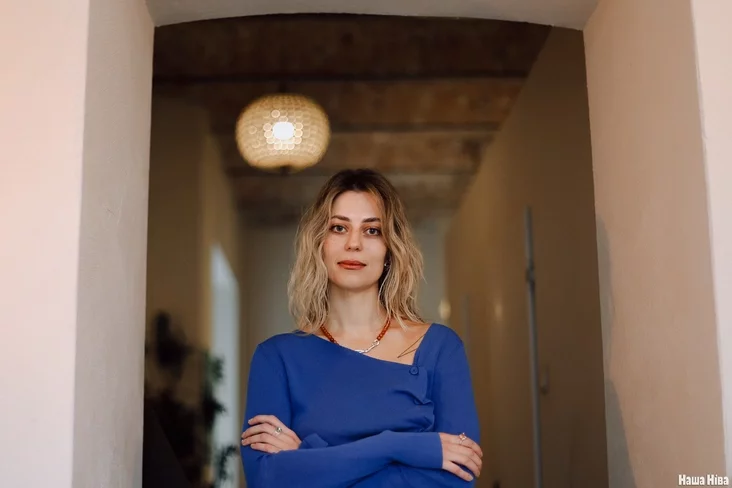
Nasta Rahatka was born in Russia (the city of Novorossiysk), spent her childhood in Ukraine (the city of Zolotonosha), and grew up in Belarus. In August 2020, she left Minsk along with the Kyky.org editorial team after the arrest of its co-founder. Kyky was later recognized as an extremist formation.
In the fall of 2020, Nasta joined Svetlana Tsikhanouskaya's team in Vilnius as Head of Communications. After leaving the Office in 2023, she co-founded the strategic communications agency StratcomLab. She lives in Warsaw.
«There was a constant tendency to downplay my ambitions, both in terms of circulation and book price»
«Nasha Niva»: Almost a month ago you presented your debut book «Carry It With You» — has the printing already paid off from sales?
Anastasia Rahatka: Only the bare printing has paid off, without anything else. But the book costs twice as much. However, I don't want to say how much I invested in it and what the print run we did yet — I plan to talk about the entire financial journey separately a bit later, because it's a really big experiment. I didn't go to a publishing house for several reasons. One of them is the commission. Plus, everyone told me that my price (20 euros — NN) is expensive for such a book. There was a constant tendency to downplay my ambitions, both in terms of circulation and price.
At the moment, I felt very sorry for all the people who are trying to write and publish books. Because «expensive» is two cocktails or three coffees, figuratively speaking. And some people write for a long time — sometimes it's two years of life, a huge internal work, sometimes also work with archives…
I wrote the book for six months, but I understood immediately that I don't want to cut back — let it be better if I don't manage to sell everything with the ambition with which I'm starting, and then I'll make discounts of 70%, 90% and so on, but at least I'll try. I want precedents to be created that you can release a book, including self-published.
«NN»: You shared positive reviews of the book, but has any negativity arrived yet?
AR: There was feedback from men that they were uncomfortable reading the part about sex. I was surprised by this, but then I realized more and more that every review is like a mirror. And the person is talking about themselves to me, not about me.
Another good acquaintance said that it was painful for her to be one of my funny stories. This was about the part that describes the first day of the war. We sat down and talked to her, but in my opinion, this is a book about millions of traumas and difficult moments.
There are friends who have read the book and say that I will still get backlash for it if a wider audience reads it. If that's the case, I'm ready anyway.
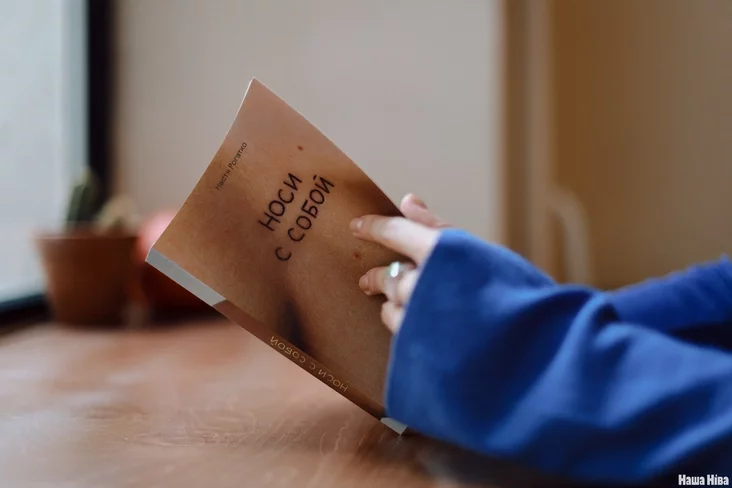
«NN»: There are many mentions of recognizable people, and one of the parts tells about your ex-boyfriend. Did you warn anyone, like, I'll write about you in my book, dude, do you mind?
AR: No, I didn't agree on anything with anyone, but at the same time I treated everyone very carefully so as not to set them up — I covered the stories with a delicate veil. I carried this decision in myself for a long time.
In general, this is autofiction, because I didn't want to make memoirs or a documentary text, like, for example, Vanya Kravtsov, who has now written his version of the events of 2020-2021. It was not important for me to tell any facts, it was important for me to make a cast of feelings and emotions. Therefore, I allow myself artistic fiction, editing and completely different techniques.
«NN»: About a separate part with a detailed description of sex, which some male readers didn't like. I also heard reviews that you read a book about various public events, and then suddenly, without consent or warning, you observe a super-intimate scene. It describes sex with Anton (Anastasia has been dating Anton Motolko for 9 years. — NN), didn't you coordinate with him either?
AR: I won't answer exactly here. I specifically and very consciously wrote this part so that a person could not get himself out of reading. And so that there would be less about me there.
Autofiction is always perceived as oversharing of some person. But there is something in it that you still go and read, hoping to find some things about yourself.
Once I went to a performance by a Belarusian woman, where you could experience the experience that performer Marina Abramovich offered in her time. We sat down with strangers, and you just had to look them in the eye. My experience was that at first I looked at the person's face for a long time, but soon everything in front of my eyes dissipated, and now you are already thinking about something of your own and about yourself.
It seems to me that it's the same with the book. And the sex scene is, of course, a performance in contrast to other stories, but for me it is no more intimate than others. It was much more difficult to admit some other things.
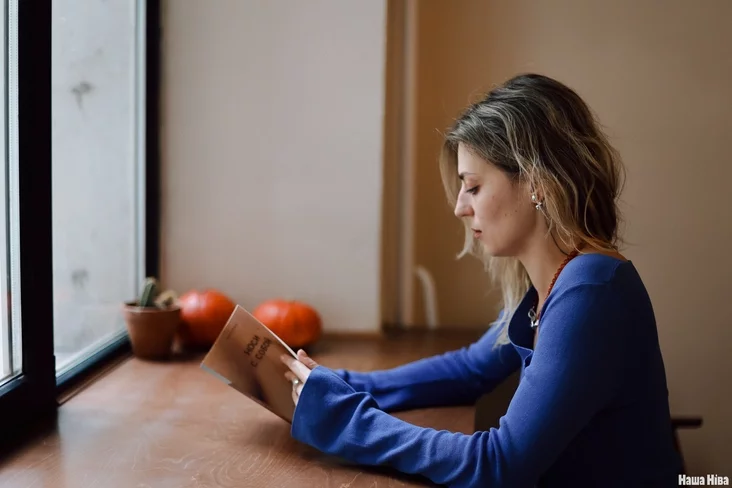
«NN»: What was the reaction to the book from your parents, in particular from your father, a military lieutenant colonel?
AR: Dad didn't say anything. But when my parents came to visit me, he asked: «Well, will you sign a book for us?» My dad is not very talkative, but I didn't even think he would read it, so I really appreciate that he did.
My mom, when she read it, called me and said that I was very brave. And I think that for her it meant that «I'm not as brave as you.» I have a great mom, but I understand that she just won't dare to do some things in life, because she has been surrounded for a long time by this «what will others think.»
When I sent the book to my mother, I wrote: «Mom, you are the person who shaped my literary taste,» — and warned that there would be a part that she might find difficult to read. But when she herself brought me «A Clockwork Orange» about ultraviolence to read when she was 13, I thought she would handle everything.
I also have relatives in Russia, to whom the book may reach — it's interesting what the reaction will be there. But no reaction will affect me anymore. In the sense that the book has already been released. I will not rewrite it and will not pretend that these are not my thoughts and not my conclusions.
«I broke off relations with some relatives after 2020»
«NN»: Are your grandparents pro-Russian?
AR: Well, yes. And I broke off relations with some relatives after 2020, and not on my initiative. I'm okay with this, because for me there is no mandatory rule that people by blood are the most important to us. I don't experience this as a loss.
But we maintain contact with my grandmother. She is a wonderful woman, delicate, caring. However, there is some part of her operating system that is completely painted black by propaganda. I try to ignore these things, because I understand that at the same time my grandmother has a lot of love for me. And we talk to her about lilac — in this spirit. I know that we will most likely never see each other again. Therefore, I just support our thread of warmth.
«NN»: What about your cousin who went to fight for Russia?
AR: Actually, I don't know the details. I have no connection with him.
«NN»: The book conveys one of the main metaphors that everything experienced leaves a mark on us, like tattoos. And what about your real tattoos, inked on your body?
AR: The first geometric tattoo was actually accidental, made by barter for the text. Initially, my friend was supposed to interview for the tattoo, but she changed her mind at the last moment. I went, decided that it would be a line that goes as if from the head to the heart. And at first it is straight and black, and then it breaks and becomes more colorful — this was kind of my story.
The second tattoo was the word «no» on the finger on which the wedding ring is usually worn (only on the left hand). It appeared after a difficult breakup and rethinking marriage as an idea and a structure. But globally, I wanted to have the word «no» somewhere, because you need to learn and be able to say «no» (especially if you are a female).
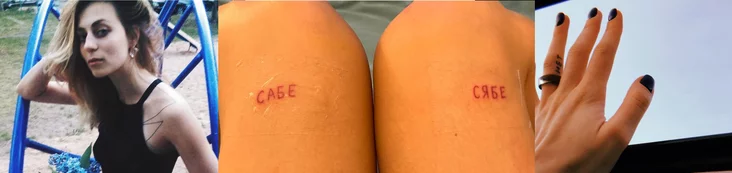
I got the third tattoo in Warsaw, in the summer of 2024. I wanted to keep something warm and Belarusian on myself. But not a map, not a flag — for me it's quite a slogan, something more intimate. And then I remembered the words «sabe-syabe», which are constantly confused. And it's not clear: are you taking for yourself or giving yourself away? So I got the last tattoo at the moment on my knees.


Comments
[Зрэдагавана]