


Who will want to create their own nuclear weapons if Americans betray Ukraine?
America's allies from Warsaw to Seoul are asking: can they rely on US protection if Washington is ready to make concessions to an aggressor?
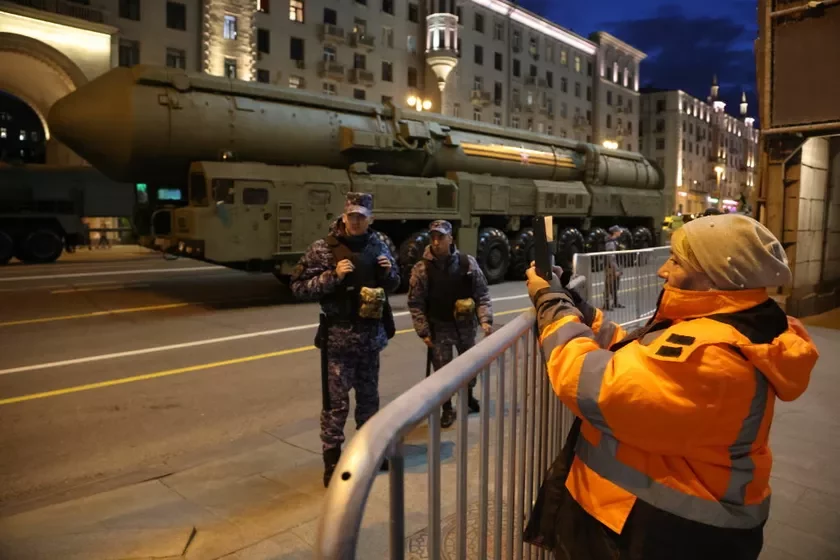
SS-29 intercontinental ballistic missile on Tverskaya Street in Moscow during preparations for a military parade. May 4, 2023. Photo: Contributor / Getty Images
Casey Michel, author of "Foreign Agents: How American Lobbyists and Lawmakers Threaten Democracy Around the World," writes about this on the pages of The Wall Street Journal.
As the analyst notes, while the new Trump administration resumes the search for peace in Ukraine, commentators' main focus is on what Kyiv will have to sacrifice to end the war. However, much less attention is paid to the global consequences of such US proposals — in particular, how they could create an incentive for nuclear proliferation.
According to the author, even the very act of pressuring Ukraine to cede part of its territories will push non-nuclear states to reconsider their security strategies. Countries without a nuclear arsenal are increasingly asking whether the American "nuclear umbrella" can be trusted.
Michel reminds that it was the United States in the 1990s that forced Ukraine to abandon nuclear weapons in exchange for security guarantees, which have since collapsed. The expert emphasizes that President Barack Obama's weak reaction to Russia's invasion of Crimea in 2014 only encouraged Moscow to further aggression. As the author notes, paradoxically, Obama, who sought to rid the world of nuclear weapons, actually paved the way for their greatest proliferation in decades.
American interests in Ukraine, according to Michel, extend far beyond the territorial integrity of one country. The main question is whether a nuclear state will be allowed to dismember a non-nuclear neighbor with impunity, and how the US will react to this.
It is entirely natural that in recent years, internal support for the idea of Ukraine regaining nuclear status has sharply increased. However, this trend is not limited to one country: across the globe, US allies are beginning to rethink their renunciation of weapons of mass destruction.
The discussion has been most acute in East Asia. Washington's allies in the region have watched as communist China absorbed Tibet and Hong Kong, and is now eyeing Taiwan.
Drawing direct parallels between Russian aggression and Chinese ambitions, South Korea and Japan are weighing the feasibility of developing their own arsenals. It is notable that in Korea, almost any discussion on this topic today inevitably comes back to the example of Ukraine.
The wave of doubts about America's reliability has also reached Australia, where the question is increasingly asked: should Canberra have its own bomb? Even Canada has not been left out, forced to consider scenarios of potential American expansionism.
The author pays particular attention to Kazakhstan. This country, which also renounced Soviet nuclear weapons, is in a similar vulnerable position to Russian aggression as Ukraine. Given Kazakhstan's possession of some of the largest plutonium reserves suitable for nuclear weapons production, Michel considers it entirely plausible that Astana might consider resuming its program.
In Europe, discussions about nuclear status are returning to Germany and Poland. The author reminds: Poland's accession to NATO in the 1990s was partly seen as a way to prevent Warsaw from creating its own bomb. As one American official recalled, the Poles said directly:
"If you don't let us into NATO, we will create nuclear weapons. We don't trust the Russians."
According to Casey Michel, Poland was right not to trust Russia. But now, as America pushes Ukraine to make territorial concessions for a fragile peace, a new question arises: should the Americans themselves be trusted? Under such circumstances, the author concludes, allies may come to the conclusion: the only reliable defense against nuclear imperialism is one's own nuclear arsenal.


Comments
ЗША гэта галоўны пастаўшчык зброі, плюс ціснуць на Еўропу, каб тая адмовілася ад расейскай нафты, каб нарэшце павялічыла выдаткі на абарону. Трамп патрабаваў гэтага ад Еўропы яшчэ ў свой першы тэрмін.
ЗША можна шмат чаго прад’явіць, але ўсё гэта чытаецца як антыамерыканская заказуха.