


A ranking of mammalian monogamy has been compiled. What place does a human take?
Humans demonstrate a high level of monogamy, but they are far from the leaders. We are more faithful than sheep, but we lose to mice.

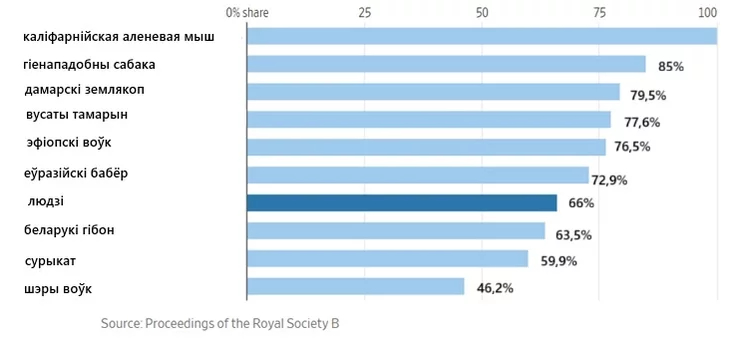
Evolutionary anthropologist Mark Dyble from Cambridge University compiled a "monogamy ranking" among dozens of mammal species. As reported by WSJ, the scientist proposed evaluating monogamy through the ratio of full and half-siblings in a population. The logic of the method is simple: in an exclusively monogamous group, all offspring will have the same parents (be full siblings). If males and females often have other partners, the offspring will have more half-siblings.
The analysis showed that less than 10% of mammals are monogamous, as males usually compete with each other and strive to leave as many offspring as possible with different females.
The most devoted proved to be California deer mice (Peromyscus californicus): in their population, all offspring are full siblings, giving a fidelity rate of 100%.
At the opposite end of the ranking were Scottish Soay sheep. Despite their resilience, they were characterized by very low fidelity in relationships — their level of monogamy was only 0.6%. They were joined at the bottom of the list by bottlenose dolphins, orcas, macaques, and black bears with rates of 4% and lower.
Humans took seventh place on this list with a result of 66%, ranking between the Eurasian beaver and the Belarusian gibbon.
The researcher notes that studying humans is more difficult due to the widespread use of contraception. We are able to separate sexual life and reproduction to such an extent that we can have various relationships for ten years and then spend twenty years in a monogamous marriage, giving birth exclusively to full siblings. You won't see this in other species. Nevertheless, if one relies purely on the genetics of offspring, humans appear to be a fairly constant species.
Scientists suggest that our distant ancestors were not monogamous, just like our closest relatives — chimpanzees and bonobos. However, about two million years ago, behavior began to change, and the main reason was the necessity of childcare. The human survival strategy requires great effort and energy to raise each individual child, so mothers critically need help with foraging and protection.
Biology dictates its terms: for a male to actively invest in offspring, he must be sure of his paternity. It was the development of monogamy that provided this certainty, transforming humans into some of the most caring parents in the animal kingdom.


Comments