


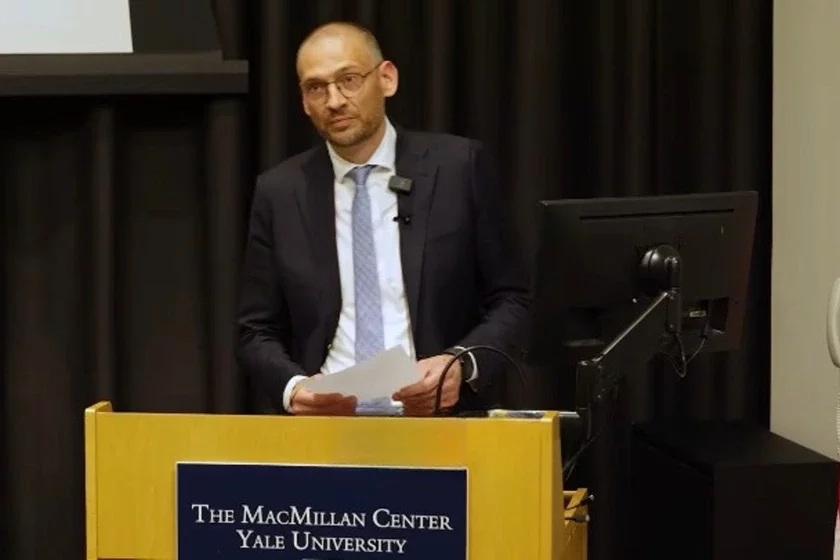
At Yale University, Tikhanovsky proposed three elements of a US strategy towards Belarus.
A former political prisoner has urged the United States not to build a strategy relying on Lukashenko, but to prepare in advance for a transfer of power. And he proposed three concrete steps to achieve this.
"If I wanted drama, I would call Netflix"
Sergei Tikhanovsky began his speech to students and faculty at Yale University by emphasizing how unpredictably quickly a person's life can change.
"A few months ago, I was sitting in a solitary confinement cell in a Belarusian prison. (...) And now I'm here. At Yale. (...) Life changes quickly. One moment you're in a cell, the next you're on stage. Sometimes life puts you in a story you didn't choose."
And if this happens, Tikhanovsky believes, "the smart move is simple - take the lead role before someone casts you in a supporting one."
Tikhanovsky noted that he was not going to act as someone asking for sympathy.
"I am not a victim. I am an enraged man with unfinished business," he said, and ironically added, "If I wanted drama, I would call Netflix. They love drama."
According to the politician, his goal is different:
"I'm here for a different reason. A reason that matters to you too. It's not just about Belarus. It's about security - your security, global security in the next ten years. And Belarus is at the very heart of it."
Briefly touching on his personal story, the politician noted:
"I'm not here to preach democratic ideals. That conversation ended a long time ago. It's useless and didn't help. Today I want to talk about something much more practical: decisions about Belarus that will determine the stability of the entire region - and the world order."
Lukashenko is a temporary figure
Tikhanovsky warned Washington against illusions about Alexander Lukashenko:
"Lukashenko is not a long-term partner. He is a temporary person pretending to be permanent. You can talk to him about tactical things - about a secret communication channel with Putin, the release of hostages, airspace violations. That's normal. That's how politics works. You don't have to like someone to shake their hand. But you can't build a strategy based on a person whose best skill is deception."
The danger of building a long-term strategy focused on Lukashenko, according to Tikhanovsky, is also in his age: he is getting old and "it is not known what will fail him first - honesty or health. And when that happens, any agreement with him will disappear."
The politician warned about the risk of inaction at the moment of the inevitable transition of power:
"If we have learned anything in the last decade, it is that a vacuum is the most dangerous player in politics. And it will arise - definitely. And someone will take its place. Geography makes the list of candidates very short. Russia will not need an invitation, and it will not take long."
That is why, according to Tikhanovsky, it is necessary to act now, because "you don't prepare for an earthquake during an earthquake."
"Finnish Model" for Belarus
Tikhanovsky categorically denied the opinion that Belarus is a "hopeless case" or has already de facto become part of Russia. He suggested considering the country as a "coin standing on its edge" and as a potential point of stabilization, not a source of constant problems.
As an example, he cited Finland during the Cold War - a country that was able to maintain independence and success next to an unpredictable neighbor thanks to restrained pragmatism.
"The Finns built an independent, stable, successful country. According to world rankings - a happy one. Belarus can become like that. A neutral, strong country - without foreign troops, without aggression, without constant crises. A country that makes the neighborhood safer. But it will only work if we start now. And not when the headlines change."
Three steps to stability
Sergei Tikhanovsky outlined a specific plan of action for the United States and democratic forces, which consists of three points:
"First: Influence. The United States must regain influence in Belarus - slowly, quietly. Real influence is relationships and presence. The embassy should return as part of the hostage deal. What's the point of having an embassy in Lithuania?
Second: Potential. Belarus needs internal capacity - people who will hold the country together. Civil servants, professionals, administrators - people who can keep things running when the system changes.
Third: Goal. The opposition abroad needs a complete reboot. Not a symbolic movement. Not a moral story. Real political force - disciplined, serious, strategic. A force that sets standards, not follows scandals."
According to Tikhanovsky, the stabilization of Belarus should not automatically turn into a head-on collision between the West and Moscow. He admits: "Moscow will always try to maintain influence there - that's a given." But, according to him, there are times when "even tough players listen," and "we can foresee such a moment."
"The United States is now talking to Russia in a rather unpleasant but practical way. Washington is trying to keep Russia from moving even closer to Beijing - and Russia knows it.
Somewhere in this space, there is room to present neutral Belarus as a sensible investment in stability - not as a victory for the West, not as a defeat for Russia, but as something that will help everyone avoid even more of a mess," the politician is sure.
U.S. Interest
Concluding his speech, Tikhanovsky addressed Washington's pragmatic interests directly. The U.S. has completely pragmatic interests in Belarus: to prevent Russian military expansion, to reduce the number of "pressure points" at NATO borders, to avoid a new crisis near Ukraine at the moment of the Belarusian transition of power, and, in the long term, to get a Russia that may become more predictable.
"Belarus is at the very heart of all this. Ignoring Belarus would be a serious mistake,"
Tikhanovsky noted and continued:
"I am not here to ask you to "save" Belarus. The era of such messages is over. I am here to show you the opportunity. A real opportunity for the United States. Stop the conflict before it starts. Stabilize the region without sending troops. Win with strategy, not force."
He is convinced that "Belarus can be stabilized, the next crisis can be avoided, a neutral model can work," but only if "people with influence - including the United States - use it purposefully. This is one of those rare moments in geopolitics when you can shape the outcome before the outcome shapes you."
"Belarus should not be a battlefield or a bargaining chip. It can be a point of stabilization - something the world needs now,"
the politician emphasized and finished his speech as follows:
"And although my whole speech today is about pragmatism, let me finish with something that every American understands: I love my country very much - really. And it so happens that a strong, stable Belarus is not only in our interests - it's in yours too! That's why I will do everything I can to make sure people here understand that."


Comments
Дарэчы, даволі цвярозы пасыл, без ружовых саплей і клішэ пра правы чалавека.
, аж нечакана.
Без галашэнняў.