


"The sovereign's word against you is this: to burn." How the Russians plundered and burned Vitebsk: an eyewitness account of the tragedy
The Great Northern War of 1700-1721 became one of the most tragic chapters in the history of Belarus, turning its territory into an arena of fierce confrontation between Sweden and Russia. The consequences of this conflict for our land were catastrophic, and the methods of warfare were ruthless. Using the "scorched earth" tactic, the Russians burned the most significant cities in eastern Belarus.

In January 1708, a 34,000-strong Swedish army, led by King Charles XII, entered Belarusian lands. His goal was to defeat Peter I in a general battle. The Russian Tsar, preparing to fight back, concentrated huge forces on the Dnieper and Dvina line: about 70,000 soldiers of the regular army and 10,000 Cossacks and Kalmyks. However, Peter I did not want to risk and engage in open battle with the Swedes on the territory of Belarus, writes on his page historian Nikolai Volkov.
Instead, the Russian command implemented a "scorched earth" tactic. Its essence was simple: everything in the path of the Swedish army had to be destroyed in order to leave the enemy without resources, provisions and shelter.
The most expressive manifestation of this strategy was the deliberate burning of Vitebsk, Gorki, Dubrovno, Mogilev and Orsha by Russian troops in the autumn of 1708.
This tactic really led to the depletion of the Swedish army, which Peter I managed to defeat near Poltava in 1709, which subsequently led to Russia's complete victory in the war.
But the price of this victory for Belarus was terrible. According to researchers, during the war years, the population of Belarusian lands decreased from 2.2 to 1.5 million people. Every third person died! These were not mass executions or battles: people were simply deprived of everything necessary for life, and they died of hunger and epidemics. As the Nesvizh administrator Yuri Tavrilovich wrote in 1711, the peasants only had "hunger and tears left."
Eyewitness account of the burning of Vitebsk
A unique and very vivid description of those events has come down to our time. Traditionally, the main source about the destruction of Vitebsk was Stepan Averka's "Chronicle of Vitebsk," written 60 years after the tragedy. However, there is an earlier and more detailed description, which belongs to the pen of Anthony Zawadzki. In 1704-1709, he was the abbot of the Vitebsk Basilian monastery and probably saw the city being destroyed himself.
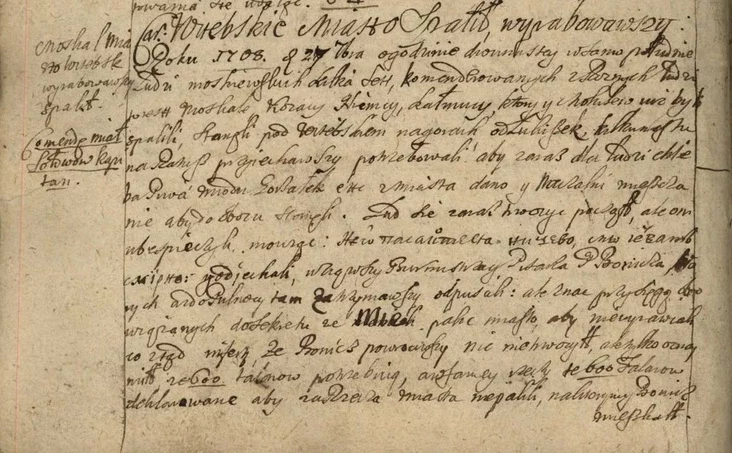
His text was published by the Facebook community Cities and towns in the Grand Duchy of Lithuania. We present this text, the lines of which allow you to feel all the horror of that September day:
"The Tsar [Peter I] burned the Vitebsk area after looting it. In the year 1708, on the 27th day of September at twelve o'clock, at high noon, several hundred Moscow people, gathered from different people, that is, Muscovites, Cossacks, Germans, Kalmyks, who had already burned Mogilev, stood near Vitebsk on the mountains on the side of Lukishek; some of them, arriving at the town hall, demanded that bread, beer, honey, vodka, etc. be immediately given to [their] people from the city, and that the main townspeople should come to the convoy.
The people immediately began to worry. But they reassured, saying: "Do not be afraid of anything, we are coming to you peacefully."
And they left, taking the burgomaster and clerk, Mr. Bonich, who, after holding them there until midnight, released them, but, apparently, after binding them by oath to secrecy that they were to burn the city [...], which Bonich, upon returning, did not alarm in any way, but only announced that 600 talers were required. But in fact, these 600 talers were promised so that the Zarechye of the city, where Bonich lived, would not be burned.
Which, however, Bonich the clerk did not inform the people, but shamefully deceived them so much that such devastation should be attributed not so much to the Muscovites, but to this secret, for it is the truest thing that if the people had been warned about this, they would not only not have allowed it to be burned, but would have chased the Muscovites themselves away at night. For already the common people began to grumble and entered the council, about which they informed His Grace Pan Samuel Kisel, the cornet and sub-governor of Vitebsk, as the owner.
He, confident in the innocence of the city, for he had given no reason, and the falsity of the statement of the Muscovites, strictly forbade, under pain of death, that no noise be made and nothing like that, and ordered it to be announced in the city under jurisdictions. And so it was done.
However, those whom Pan God wanted to save in the fickle fortune began at night to take out and take out their best things, hiding them in the ground.
For one good Moscow man, well known to some, wrote to his brother: "Beware, they will burn the place." And this word reached the knowledge of only a few.
Early on the day of September 28, as soon as the sun rose, having moved from the mountains to the city, [the troops] stretched throughout the city and all the way through Uzgorye to the other side, and there they spread out: some - on the mountains above the city, some, already quartered in the city, divided up where to rob and burn.
And the commandant Solovyov himself, having entered the town hall with more than a dozen horses, ordered that all high ranks should gather immediately: in other words, district, city, spiritual, as well as Jews and others - to listen to the sovereign's word.
Meanwhile, one Muscovite, Bonich, moving away from the town hall, ordered his nephew Bonich to be notified that they would be burning.
That immediately spread among the people, so that [...] women began to howl, cry, lament in the city, and the chiefs could no longer go to the town hall - staying at home, they tried to save what they could, save from the fire.
Without waiting, standing for half an hour and nearly an hour, Bonich finally declared to him that those people were already disturbed by rumors that you intend to do, there will be no chiefs here anymore.
Only then did he say: "The sovereign's word to you is this: that you, the Vitebsk people, are zealous for the Swede and give provisions to the sovereign's enemy, you are ordered to be burned. [...]".
Immediately the city was filled with weeping and shouting, and whoever had something more expensive, grabbed it and wanted to take it out. No more than an hour and a half passed, and they began to rob all over the city, and first of all they stripped people to their underwear, looking for expensive caches or money - and that's how they treated people of all classes.
The first to be stripped to his underwear and unshod was His Grace Pan Samuel Kisel, the cornet and sub-governor, and that in the middle of the street, and those nobles who were with him, such as Pan Waclaw Shapka, the Vitebsk guard, and others.
And immediately, having begun to rob, they began to set fire, and set fire to the monastery of our ladies of the Basilian order at the Church of the Holy Spirit - not only the monastic housing, but the bakery and other things.
And everyone in his apartment, after robbing, set it on fire. And when it flared up, they left, and drove each other out of the city, and already near the city, where they could catch someone, they stripped them, the nobles, women and others.
When the fire had already engulfed the city, and everyone had been driven out of the city, they divided all the loot, choosing what was better, and took what they could take, and threw away the rest and left themselves.
Until dark night, the whole city with monasteries, churches, etc. burned down, leaving only a field strewn with ashes and embers.
The cathedral church, which was under restoration for seven years before the fire and had not yet been completed, also burned down.
A large bell weighing 120 stones (stone - a measure of weight in the GDL equal to 40 pounds or 14.993 kg - NN) and four smaller bells burned down to slag (slag - NN). The monastery, built in 1706, was completely reduced to ashes. In that confusion, when the city was already smoldering, several Cossacks and Kalmyks who were still wandering around were killed by [our] people. On one of them they found only small coins [the amount of money robbed from the townspeople], which amounted to 2000 zlotys.
And one Kalmyk was cleverly deceived by a peasant in this way. The Kalmyk, already weighing full packs, still making his way to the hut, or rather, the barn, called the peasant and gave him the horse to hold, and he himself was looking in the hut. The peasant locked the door and latched it, and grabbing fire, placed it under the hut, and having sat on the horse, drove away, and the Kalmyk burned in the hut."
«Nasha Niva» — the bastion of Belarus
-
"Poland flourishes in Latin, Lithuania flourishes in Ruthenian". A patriotic masterpiece of the 17th century turned out to be a Russian forgery of the 19th century.
-
In Vilnius, the site of the Radziwill Italian garden and the main arsenal of the Grand Duchy of Lithuania has been excavated. Elite housing will be built here
-
"The Dutch architect" who rebuilt the Gate of Dawn and built himself a fortress-house in Hajciuniški, turned out not to be Dutch at all. But his legacy is captivating
Now reading


Unique photos of the construction of the Old Bridge in Grodno. Who photographed the dangerous caissons in which people risked their lives at the bottom of the Neman to place the supports? MANY PHOTOS

Unique photos of the construction of the Old Bridge in Grodno. Who photographed the dangerous caissons in which people risked their lives at the bottom of the Neman to place the supports? MANY PHOTOS


DDoS attack targets websites of several Belarusian media outlets simultaneously. It may be related to the sixth anniversary of the 2020 popular uprising and the "New Belarus" conference, which opened today

DDoS attack targets websites of several Belarusian media outlets simultaneously. It may be related to the sixth anniversary of the 2020 popular uprising and the "New Belarus" conference, which opened today

"Poland flourishes in Latin, Lithuania flourishes in Ruthenian". A patriotic masterpiece of the 17th century turned out to be a Russian forgery of the 19th century.


Comments