


What unique tiles, excavated in Navahrudak and taken to St. Petersburg, can tell us
In the funds of the State Russian Museum in St. Petersburg, among masterpieces of world painting and sculpture, a modest, at first glance, but unique collection for our history is preserved. These are 73 fragments of ceramic tiles from the 16th-17th centuries, found on the territory of ancient Navahrudak. They allow us to look anew at the daily life and artistic tastes of Belarusians during the times of the Grand Duchy of Lithuania.
In the latest issue of the journal «Actual Problems of Art Theory and History,» researcher Elena Popova published a thorough analysis of this collection, which was highlighted by the Telegram channel «De facto. Belarusian Science.»
This collection is not a random trophy, but the result of painstaking scientific work. It entered the museum's repositories back in 1979, as a result of large-scale archaeological expeditions in the 1950s-60s under the leadership of the legendary Fryda Gurevich. Excavations were carried out on the territory of the Navahrudak settlement — the so-called Small Castle. And while previously scientists often focused on the pre-Mongol period of the city, the current research brings back from oblivion a later era — the 17th century, when Navahrudak, although having lost its capital status, remained a bustling center of craft and trade.
The most interesting thing about these clay shards is that they speak of a peculiar «democratization» of luxury. The study showed that Navahrudak had a developed tile-making industry that literally worked for everyone. Local craftsmen used the same wooden matrices to produce products of different price segments.
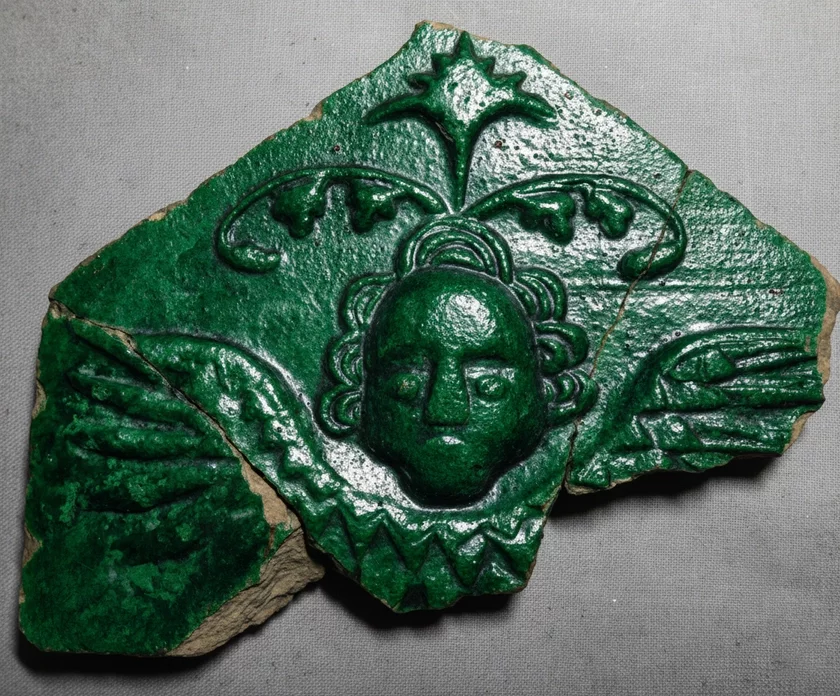
For wealthy townspeople, «glazed» tiles, covered with green glaze, were made, and for poorer strata — ordinary terracotta («red») ones. Thus, even in the house of a simple artisan, the stove could have the same exquisite Renaissance patterns as in the house of a rich merchant; the only difference was in color and shine.
At the same time, Navahrudak craftsmen had their own unique technological style. Unlike many Eastern European colleagues, they did not use engobe — an intermediate layer of white clay under the glaze. The green glaze was applied directly to the red shard, which gave the products a darker, richer, and deeper shade.
As for the subjects, the Navahrudak stove of that time was a true encyclopedia of European artistic styles, translated into the language of local culture.
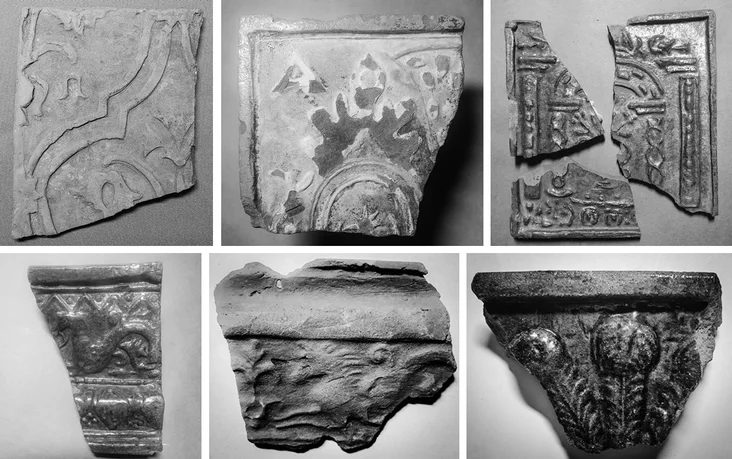
Here you can see echoes of the Italian Renaissance: for example, complex geometric grids that imitated «diamond rustication» (volumetric decoration of stone palaces). Motifs of Dutch floral still lifes are also found — vases with bouquets in arched openings, which was very fashionable at that time.
Particularly endearing is how local potters interpreted complex mythological images. On the tiles, one can find, for example, hippocampi — sea horses with fish tails. But if in Vilna or Krakow these creatures were depicted with anatomical precision, characteristic of high art, then in Navahrudak they acquired features of naive simplification, turning into fairy-tale characters.
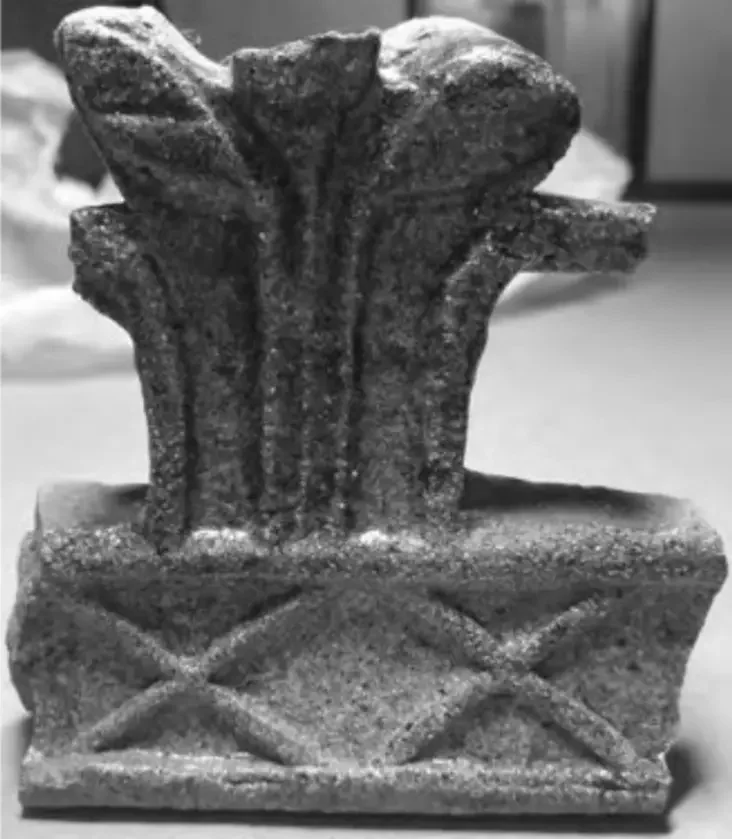
Among the ornamental scattering, a single polychrome fragment (unfortunately, all photos in the publication are black and white. — NN) stands out, depicting the «Leliwa» coat of arms — a six-pointed star above a crescent moon. This is a sign of the elite's presence: powerful families such as the Tyszkiewicz, Hlebowicz, and Moniwid used such a coat of arms. The presence of such an example indicates that local workshops also fulfilled individual noble orders of high quality.
According to the researcher, Navahrudak tiles are not a provincial copying of Western patterns. This is an example of a living cultural synthesis. Located at the crossroads of paths, Belarusian craftsmen absorbed European trends — from the ornaments of oriental carpets to Baroque splendor — but reprocessed them through the prism of their own vision and technical capabilities.
It is precisely in this sincerity, in the combination of high European fashion with the immediacy of folk craftsmanship, that the secret of Navahrudak ceramics' charm lies.
«Nasha Niva» — the bastion of Belarus
SUPPORT US


Comments
Сучаснасць: распавядаем аб нашай гісторыі па таму, што было вывезена ў Масковію: кнігі, крыжы, кафель