


Why modern tushonka is stored for only 2 years, while in Soviet times it lasted many times longer?
Why in the USSR tushonka could easily be stored for about 10 years, while modern producers limit the shelf life of their products to 2-3 years? Is this related to the quality of the meat used to make tushonka, or is it due to some "secret technologies" that were allegedly lost after the collapse of the Soviet Union? The director of the Moldovan meat processing plant Mezellini, Angela Gheorghita, revealed production secrets,Telegraf.news writes.
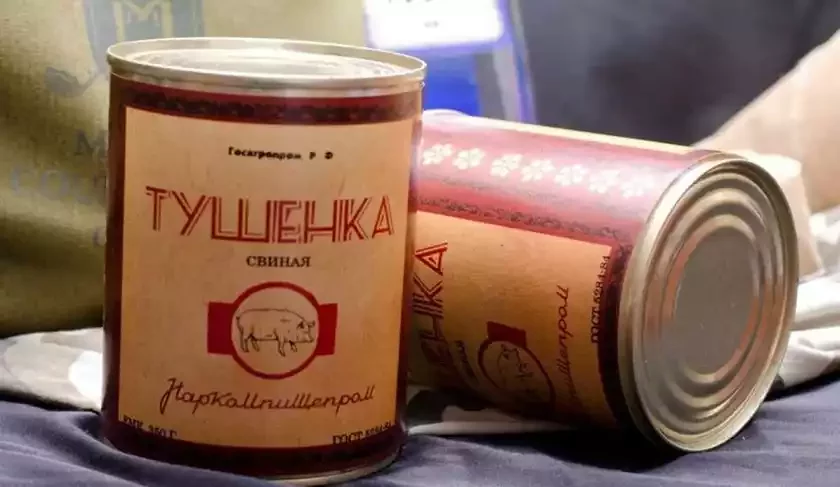
Illustrative photo
According to the head of the meat processing plant, the reduction in shelf life is in no way related to the quality of the product itself.
Meat has nothing to do with it. It's all about the materials used for the packaging. Previously, tushonka was sealed in much thicker metal, which ensured better preservation of the meat product.
Gheorghita clearly demonstrated how the weight of an old Soviet can differs from a modern one — 69 grams versus 34 grams. This means the packaging weight has been halved.
Moreover, military tushonka from strategic reserves (most often mentioned in comments as proof of quality) was stored under special conditions — in oiled paper or paraffin and in wooden boxes, without paper labels. These were affixed separately, only after opening the box. Under such conditions, tushonka could indeed be stored for a decade, although factories, in accordance with the state standards then in effect (GOST 8284-84), set the shelf life at only 6 years.
Now, of course, no one stores tushonka under such conditions. Moreover, according to Gheorghita, up to 90% of tushonka today is produced not in tin cans, but in glass containers. It, according to the director of the meat processing plant, is bought much more willingly, because people "don't trust" manufacturers' words and "want to see for themselves — whether there is meat there or not".
Such glass packaging has a "weak spot" — the metal lid. It is precisely because of it that the shelf life is limited to two or three years; after that, the lid can oxidize and metal corrosion can begin, which breaks the seal of the jar, and the meat spoils.
For some reason, there is an opinion that tushonka from the USSR, which was stored for 10 years or even longer – is of higher quality than modern tushonka, whose shelf life is 2-30(26267; ? Why? State Standard 8284-84 for canned meat set a storage period of up to 6 years. At the same time, for canned goods intended for long-term storage, special packaging w ‑ (’ tin can –#1 and Family Market, made of thicker tin), with special internal and external treatment. Such packaging was wrapped in oiled paper, placed in wooden boxes, and stored in cool rooms. Under such conditions, the storage period could indeed reach 10 years. However, 90% of tushonka nowadays is produced not in tin cans, but in glass containers. That's why the shelf life is limited to 2-3 years. Why? Because it's glass, it's an aluminum lid, it oxidizes, it rusts and becomes inusable. Our tushonka (meat) – 100% natural product: beef, pork, chicken (without fat), only meat, salt, pepper, bay leaf. We make delicious and healthy tushonka, which you can buy at Mezellini.md.
By the way, that is precisely why, when buying tushonka, you should carefully inspect the can — both glass and metal. In case of mechanical damage to metal packaging — strong dents — or the appearance of rust, the special protective layer inside may be damaged, so consuming tushonka from damaged packaging can be dangerous to health.
However, according to Gheorghita, for modern manufacturers, there is no problem with such "time limitations" of new technologies. The director explained that in the absence of a shortage of meat products, consumers do not need to make such long-term reserves, so there is no point for manufacturers to go to great lengths to extend the shelf life of tushonka, which will most likely be eaten immediately after purchase.
"The filling is high-quality — I vouch for that. There's simply no task to store it for a long time," Gheorghita explained.


Babaryka and Kalesnikava Spoke with Inga Ruginienė and Called on Lithuania "to Join US Diplomatic Efforts" and "Not to Miss the Window of Opportunity"


Comments
Раскрыла таямніцы,
Якую тушонку выбраць,
Каб з'есці і не атруціцца.