


Police, BT, and thousands of bots. Researchers reveal who is manipulating Belarusian TikTok and how.
The FactCheck.LT research team conducted a study of the Belarusian segment of TikTok and discovered a bot factory that mimics popular support for the authorities and harasses opponents on a strict schedule. We present the main findings.

In October 2025, analysts at FactCheck.LT conducted a comprehensive analysis of 21 Belarusian TikTok channels, covering various audience segments - from news channels to lifestyle bloggers.
Initially, they wanted to check for coordination between channels linked to government agencies or demonstrating pro-government rhetoric. But the results exceeded their expectations.
The authors studied the activity of 21 channels with a total of 5 to 7 million views per month. In just one month of observation, this group created 1,770 videos and generated 52,144 comments. Metadata on publication time, likes, comments, and hashtags used were analyzed. A total of 27,741 unique users were included in the sample.
Data was collected through the professional analytics platform Exolyt and through public TikTok interfaces.
As a result of the analysis, the researchers derived an integrated "coordination index," which for the studied network amounted to a critical 91.7 out of a possible 100 points.
This is the sum of four independent metrics, each of which checked a separate aspect of behavior: abnormal coincidence of commentators (30 out of 30 points), unnatural intersection of audience (30 out of 30), synchronicity of publications in time (20 out of 20), and coordinated use of hashtags (11.7 out of 20).
Complex structure: five clusters and a "core"
The composition of the core of these channels is very indicative: it includes the official accounts of state television @ctv_by (CTV) and @ont.life (ONT), supposedly independent news blogs like @belarushh7, as well as personal accounts, such as lifestyle blogger @prosto_olechka or religious channel @priestblr.
The analysts pay special attention to the hierarchy within the network. The main "conductor" is the @belarusseychas channel, which sets the pace for the entire network (participating in 41% of synchronizations). However, law enforcement agencies also play an important role: the official account of the Ministry of Internal Affairs @mvd_by, which was involved in 23% of cases of synchronous activity, was among the top 3 most active coordinators.
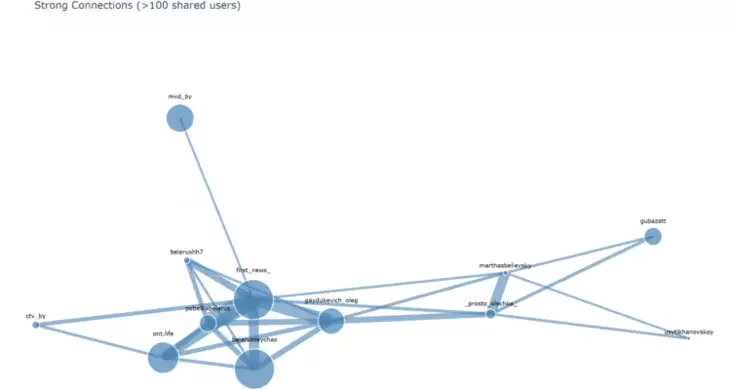
This is evidence that what we are seeing is not an expression of the civic position of individuals, but a planned information operation with the direct participation of state bodies.
Mathematical proof: abnormal synchronicity and office schedule
The artificiality of this network is particularly evident in the anomalies of time and behavior. The researchers drew attention to the bloggers' activity schedule, which looks extremely suspicious.
Synchronization peaks occur at 9-10, 10-11, 13-14 and 16-17 hours - a classic office work schedule. The dramatic decrease in activity after 19:00 and the almost complete absence of night synchronizations shows a professional team working regular business hours.
Even more impressive is the abnormal synchronicity: 83 cases were recorded when different channels posted videos almost simultaneously, within one minute. At the same time, 13 publications appeared with an interval of less than 10 seconds.
The researchers emphasize that from a mathematical point of view, the probability of such a random coincidence is negligible (less than 1 in 10 to the 80th power), which is actually a strict proof of automated or pre-planned content placement.
In other words: if these were 21 independent bloggers, they could accidentally hit the same minute once, but 83 times a month - this is no longer a coincidence, but a pattern indicating a single management or planning.
Army of bots and "emoji boosting"
To promote their narratives, the network uses large-scale bot support. The authors of the study analyzed the behavior of the audience and identified 4,641 users who are active on several channels of the network at once. This is 16.7% of the total audience, which is 5-7 times higher than the natural indicators for TikTok.
For comparison, usually in TikTok the level of such audience crossing is only 1-3%: out of a hundred commentators of one channel, only one or two usually also go to another similar channel. Here, almost every sixth user simultaneously feeds several different accounts.
However, the main danger lies not in the bots themselves, but in the amplification mechanism that allows you to deceive the platform's algorithms.
The bot network instantly reacts to videos, leaving thousands of comments consisting exclusively of emojis.
This type of spam is not chosen by chance: it is more difficult to catch with an automatic filter than the same text. The TikTok algorithm, seeing a sharp surge in activity (engagement), mistakenly considers the video interesting and begins to promote it to the recommendations of real, unsuspecting users.
Thus, the artificially created narrative goes beyond the bot network and enters the minds of ordinary Belarusians already under the guise of "popular public opinion."
Hashtags
The use of hashtags deserves special attention. Tags dedicated to Tikhanovsky and the opposition turned out to be 80-100% monopolized by this network and were always used in a negative context.
The researchers also noticed the use of the hashtag "opposition" with a deliberate spelling error - this technique was used only by network channels to ridicule in 100% of cases. It is significant that not a single ordinary Belarusian TikTok user used such tags - only propagandists.
On the contrary, the hashtag #presidentbelarusi (94.5% of the use of which falls on the network) works exclusively to create a positive image. Note that ordinary people do not use this tag either.
At the same time, researchers emphasize: hashtags are important, but not the only proof.
Why it is important for every Belarusian to know this
The investigation emphasizes that TikTok has become an ideal field for such manipulations precisely because of its specifics. The short video format leaves the viewer no time for critical reflection and verification of facts, the young audience is more receptive to bright images and tends to trust what is "popular," and the closed nature of the algorithms allows bots to simulate popular support.
Now reading


Babaryka and Kalesnikava Spoke with Inga Ruginienė and Called on Lithuania "to Join US Diplomatic Efforts" and "Not to Miss the Window of Opportunity"


Comments
Таму што баяцца як чорт ладану, тут карціна маслам.
Карціна маслам, што блытаныя тэзісы Пазьняка і шматслоўныя выступленні Усава абсалютна ў рэчышчы і пад кантролем рэжыму.