


Moscow's perception of Trump has changed, talks of treachery and unreliability emerge
Dmitry Trenin, Director of the Institute of World Military Economy and Strategy at the Higher School of Economics and former head of the Moscow Carnegie Center, published an article explaining how Russia should now perceive Trump and US policy in general. Trenin is a person whose views are close to the Russian leadership, so his perspective is worth considering.

Vladimir Putin and Donald Trump in Anchorage, Alaska on August 15, 2025. Photo: AP Photo/Julia Demaree Nikhinson
Trenin begins his article by analyzing the transformation of Donald Trump's policy. He recalls that at the beginning of his second term, Trump spoke of his mission to "make America great again," of abandoning liberal globalism in favor of pragmatism, "from defending and promoting the interests of the American empire to turning towards his own country and its problems." Such a policy, in the expert's view, also included "recognizing the diversity of the world and the existence of several great powers with whom the US must negotiate."
“The beginning of his new term was vigorous,” Trenin says, implying that Trump's steps gave Russia hope for a redistribution of the world into spheres of influence. He recalls the resumption of Washington's contacts with the Kremlin and the development of an understanding regarding ways to resolve the Ukrainian crisis (“Spirit of Anchorage”). However, this success proved short-lived, as, the author argues, the settlement process quickly stalled due to resistance from European allies and the American establishment.
As a result, even limited steps to improve relations between the US and Russia did not happen, and sanction pressure on the Russian energy sector only intensified.
Washington ignored proposals to preserve the Treaty on Measures for the Further Reduction and Limitation of Strategic Offensive Arms (START-3), whose term expired earlier this year, which ultimately destroyed the nuclear security system.
At the same time, as Trenin emphasizes, US foreign policy has become even sharper and more forceful. Evidence of this includes the operation in Venezuela, strikes on Iran, and talks of "regime change" in other countries.
“In fact, instead of the outdated hegemony of the collective West, built on liberal-globalist principles, Trump is now trying to establish a sole global hegemony for the US, but already on a purely power-based foundation. (…)
The state that was 'falling asleep' under Biden-'Chernenko' has gone on the offensive under Trump. Washington's goal is not so much to establish a new world order as to generate global chaos in order to dominate it,” asserts the Russian expert.
What is to be done?
Answering the question "What is to be done for us?", Trenin argues that such a policy by Washington "objectively makes the United States a geopolitical and potentially military adversary of Russia." He emphasizes that even after Trump's return to the White House, Washington has not ceased to be an adversary of Moscow in the Ukrainian conflict.
“This does not mean that an attack on Russia will necessarily follow the attack on Iran, but strategically, the Trump administration's aspirations are leading the US to a confrontation with our country,” the expert argues.
“It is the Supreme Commander-in-Chief's business and right to decide how to continue the special diplomatic operation (dialogue with Trump),” Trenin notes, observing that this dialogue has already yielded certain results: it helped partially distance Trump from the Ukrainian conflict, intensified disagreements between the US and Europe, and presented Russia as a country that “strives for lasting peace.”
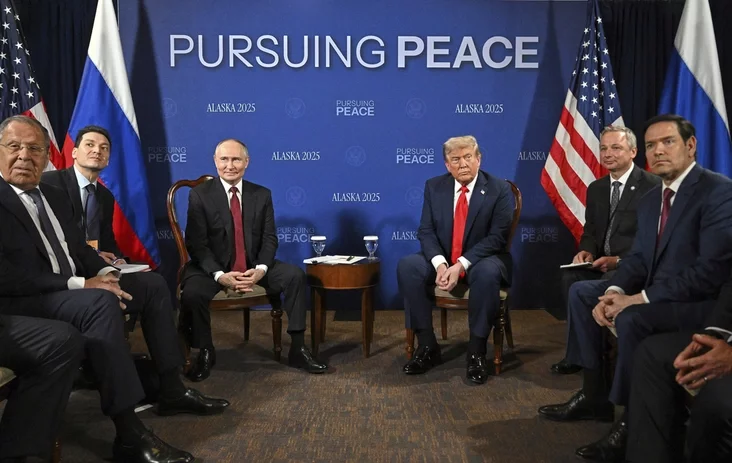
Negotiations in Anchorage. August 15, 2025. Photo: AP Photo/Julia Demaree Nikhinson
However, the expert assesses the prospects for diplomacy skeptically, believing that the Ukrainian president is "completely and hopelessly inadequate," "Europe is preparing to fight Russia," and Trump himself may weaken after the November congressional elections and the unsuccessful development of the Iranian campaign.
Separately, Trenin warns of Trump's unreliability as a partner. As an example, he cites the behavior of the US towards Iran in 2025 and 2026, which he calls "treachery."
“An additional piquancy to the situation is added by the fact that the American negotiators on the Russian-Ukrainian and Iranian fronts are the same people, maximally close to the head of the White House. Trump is literally the master of his word, in other words—an unreliable partner. This does not mean that one cannot communicate with him; it just isn't necessary to believe him (or his signature),” the expert instructs and continues to escalate:
“One should also not forget for a moment that the real American military doctrine sets the task of neutralizing (decapitating — literally) the supreme leadership of an adversary state at the very beginning of a conflict. Russia's security guarantees — including in the Ukrainian direction — can be ensured primarily by Russia's own military means. Here, one will have to rely only on oneself.”
In the expert's view, Russian-American relations in the near future will be very limited. He notes that the era of strategic arms control has effectively ended, and "strategic stability in the world has critically weakened."
“A re-evaluation of the situation in a multipolar nuclear world is required, and first and foremost, the development of new models of deterrence and stability jointly with Russia's Asian partners — China, India, Pakistan, North Korea. It is necessary to remain in constant contact with Washington to prevent dangerous misunderstandings in crisis situations, but negotiations and even consultations conducted in old forms have definitively lost relevance,” Trenin writes.
In his opinion, the US and Israeli wars against Iran have dealt a strong blow to the nuclear non-proliferation system, which "today more than ever serves as the only real guarantee against an attack by the US." At the same time, "Washington's de facto refusal of nuclear security guarantees to its allies in Europe, Asia, and the Middle East is pushing these allies to create their own nuclear arsenals or expand existing ones."

Trump and Putin's press conference after talks in Anchorage. August 15, 2025. Illustrative photo. Photo: AP Photo/Jae C. Hong
What about the economy?
In the economic sphere, Trenin also sees no rapid improvement in relations. Although the potential for cooperation between Russia and the US is theoretically large, he believes it is unlikely in practice.
“Anti-Russian sanctions are 'serious and long-term'. Most of them are introduced by US laws — these sanctions cannot be revised by the president. The majority of currently living Russian citizens will not see either the abolition or even a significant weakening of these restrictions. It makes sense for us to accept the current state of affairs as a long-term reality and build our geo-economic strategy with an emphasis on internal development and relations with non-Western partners.”
Trenin emphasizes that cooperation between Moscow and Washington on regional issues has effectively turned into confrontation. He cites examples of Venezuela, Iran (calling this country "Russia's strategic partner"), Cuba, North Korea, and China ("Russia's main international partner").
“In all the listed directions, it is in our interest to strengthen relations with partners and allies who are subject to pressure and threats from the United States. Their resistance can slow down or stop Trump's counteroffensive. America itself will never stop,” Trenin concludes his analysis.
Now reading


Japanese man rented apartment where his wife was murdered for 26 years to preserve evidence in hope of new technologies. And finally, the killer was found


Comments
И кто же, [Рэд. Выдалена], такой коварный это все начал?
[Зрэдагавана]
Калісці ..5 год таму эксперт аналітык " цэнтр Карнэгі" Масква была як знак якасці дзля кагосці ...
Але і 5 год таму было вядома і аб Тренеке дырэктаре і адкуль ен..