


A dugout canoe is not built, it is found inside an oak. A craftsman in Polesie makes unique boats
Leonid Shvets carves boats from a solid oak log — just as the ancestors of today's Poleshuks did over a thousand years ago. The folk craftsman lives in the village of Perarov, Zhitkovichi district. He has 28 ares of land, laying hens, a small apiary, and a rare skill today: he knows how to make Pripyat dugout canoes, or "chovny" as they are called here. The Times.by publication came to see the "swamp all-terrain vehicle".

Grandfather's Adze and a Willow Trough
In Leonid Shvets' yard, everything is business-like: utility buildings in a line, neatly stacked firewood, on hooks — wire next to wire. Near the white brick house are a homemade table and bench. Behind the chain-link fence is a vegetable garden plowed for winter.
Near one of the sheds, a cast-iron aggregate resembling a large meat grinder attracts attention.
"That's a chaff cutter," the owner catches my gaze and opens the lid of the pre-war mechanism. "It was inherited from grandfather Nichipar. The gears, the knives — everything is in place. It can chop any grass even today."


Grandfather lived in the neighboring village of Khvoensk, and was the best carpenter in the district. The tools he used to hollow out his dugout canoe have been preserved to this day.
Leonid shows an object resembling an axe, and two drawknives — one with a straight blade and one with a curved blade. Everything is homemade, once forged in a Polesie smithy.
"This is an adze," the craftsman says, pointing to an axe shaped like a foot with ends bent on both sides. "This is used to hollow out the middle of the trunk. This is done after the sapwood — the first layer under the bark — has been removed with a regular axe."

According to Leonid, a round drawknife is used to smooth the dugout canoe walls to the desired thickness.
"Now I'll show you," he says and disappears behind the shed. A couple of seconds later, he returns with an object resembling a deep tray.
"Do you know what this is?" the owner teases, and without waiting for an answer, reveals: "It's a trough. My grandmother used to proof pampushki (a type of doughnut/bun) in these. You can also wash clothes and bathe children in them."


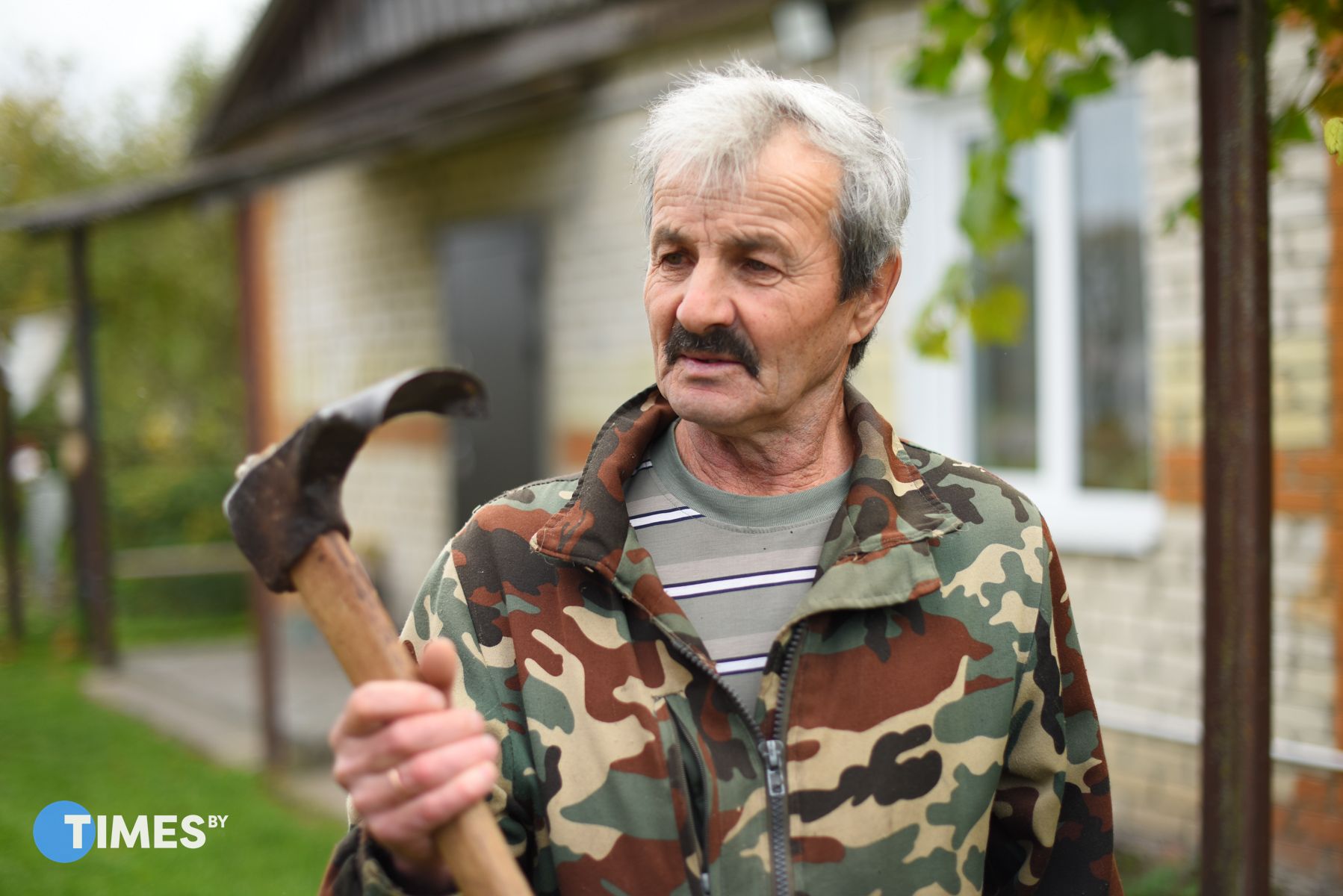
Photo: Times.by

Grandfather Nichipar carved this trough from willow more than half a century ago.
"I was about seven years old then. He made them in a day. I remember telling my grandfather: 'I want to do that too, teach me.' And he laughed: 'First learn to distinguish oak from elm — then you'll make not only troughs but also a dugout canoe.' I still remember his words."
"My Feet Lead Me to the Water"
Leonid Shvets is 63 years old. He moved to Perarov from a neighboring village in 1990 when he got married. Before that, he worked as a driver in the North, managed to study to be a driller, and served in the army.

Perarov village is small today.
"About one hundred twenty people are left. The old ones are dying, and there are few young people. Although there is enough work both in the Pripyatsky National Park and in the large farm 'Agro-Lyaskavichi'. If there were a desire," says Leonid.
For the last fifteen years, Leonid Shvets has worked as a pump station operator, monitoring water levels in reclamation canals. In his free time, he fishes.
"If you count how many days I've spent on the river versus at home, the former would probably be many times more. Now I go fishing less often. But my feet lead me to the water themselves. If not to fish, then just to stand on the shore, to breathe the Perarov air."

Just a day ago, Leonid crossed to the other side of the river. His bees are there, in the forest. The fastest way to get to the hives is by boat.
"I crossed the river — and I was there. If I had gone by car, I would have wasted three hours. There's a lot of detouring to do," explains the Poleshuk (inhabitant of Polesie).

Previously, in Perarov and the surrounding villages, every owner had a dugout canoe. It's understandable: when the Pripyat encroached upon the village, no vehicle could pass. Floods were so strong that they uprooted century-old oaks.
In recent years, high water has been an infrequent guest in Perarov, so seeing a wooden boat on the river, let alone a dugout canoe, is a great rarity.
But not for Leonid Shvets. His time-blackened rarity and a flat-bottomed boat built from planks are permanently moored near the shore.

Lessons from the Maslo Craftsmen
Leonid Shvets built his first boat from planks at fourteen years old.
"Nothing unusual. Previously, every boy in Polesie knew how to make flat-bottomed boats. I come from a family of carpenters, it was destined for me," says Leonid. "But only a few hollowed out dugout canoes using the ancient technology."
Leonid first took lessons in craftsmanship from grandfather Nichipar, and when he moved to Perarov, from his neighbors — namesakes by surname, Vasiliy Fomich and Viktor Yakubovich Maslo. They made dugout canoes for sale and knew more about them than anyone else in the district.

They also taught that the best material for a dugout canoe is oak, but one must know how to choose it from fallen trees (a tree that has fallen. — Ed. Times.by). And it's not just about the height and diameter of the trunk. An outwardly strong oak could turn out to be unsuitable. The Maslos showed how to check this.
"First, you need to cut off part of the bark, then remove the sapwood layer, which is another 3-4 centimeters. When you reach the working part, split off a chip from it and throw it in the water. If it sinks — the oak is bad for a dugout canoe, turn around and go. If it floats — get to work," the Poleshuk recalls the Maslos' lessons.

The craftsmen worked directly in the forest. They hollowed out dugout canoes by hand; they had no power tools.
"I saw with my own eyes how once, in the morning, the Maslo uncles went across the river in one dugout canoe, and in the evening they came back in two. That's how strong people were. Usually, an experienced craftsman needed a week to get a dugout canoe on the water," Leonid draws parallels.
He made his first dugout canoe at 36 years old and realized: the work is very hard. He wore his palms down to bloody calluses. That's when he understood why his father bought a dugout canoe instead of making one himself, following his grandfather's example.

Leonid worked in the forest for a month, but the process captivated him so much that he decided to take up the adze at least once every three or four years. Today, he is the only master of Pripyat dugout canoes in all of Belarus.
Leonid is constantly invited to share his knowledge at the ethno-cultural traditions festival "Call of Polesie." Oaks for master classes are brought to the festival site by the Pripyatsky National Park.

"What do people usually ask about? Most often about the dimensions of the 'swamp all-terrain vehicle' — that's what one guest once called my dugout canoe," Leonid laughs. "The length should be 5.2 meters, the width at the front — no less than 85 centimeters. Towards the stern, it gradually narrows."
With such dimensions, the master says, the dugout canoe turns out stable and swift, outperforming any other wooden boat. "Let's go to the river, I'll show you," he offers.
"The Dugout Canoe Doesn't Float — It Rustles"
From Leonid's yard, they walk to a forest backwater. Near the bank of the old Pripyat riverbed, a dugout canoe and a flat-bottomed boat sway on the water.
Leonid lists the differences without long thought. A dugout canoe has more advantages than a regular boat. It is faster, more maneuverable, and navigates overgrown bodies of water better.

"The distance you'd cover in an hour by boat, you'll do in 35-40 minutes in a dugout canoe," says the master. "And a good dugout canoe is so obedient that it senses the slightest movement of its owner."
For a fisherman, this is a great advantage, especially when trolling.
"And in fishing backwaters and old river channels, where there's grass and bushes, the dugout canoe doesn't float — it rustles. So yes — a swamp all-terrain vehicle, nothing less," the Poleshuk smiles.

To steer a dugout canoe, one paddle is enough. According to Leonid, there is no universal size.
"I choose the paddle's height according to the fisherman's height, and its thickness so that the fingers meet and it's comfortable to hold. The paddle should not rise above the knee, and its width should not extend beyond the palm," the master demonstrates. "Make it bigger, and your back will start to ache, and it will be difficult to steer."


Leonid carves paddles from ash. He says it is stronger and more durable than pine and willow.
The Pripyat dugout canoe has another feature — it's best to store such a boat in water.
"It's even wiser to leave a dugout canoe under the ice for winter than on the shore. The sun shines at any time of year — it dries out the wood. And moisture is its natural environment," explains the master.

At first glance, the dugout canoe seems unstable: it looks as if it will capsize any moment. But no, that's a deceptive impression. The dugout glides easily and quickly across the water's surface.
An Expensive Craft
After the river excursion, Leonid suggests going into the forest. Ten minutes of wandering, and he finds what he wanted to show.

He embraces the trunk of a huge oak, estimates its height, and concludes — "it would make a good dugout canoe."
"Slightly more than a meter in diameter. About six meters to the first branches, and no knots," the master praises the tree. "And you see — there's a characteristic curve for a future dugout canoe. That's wonderful."

But you can't just go into the forest and cut down a tree today. You need to contact the national park for permission.
"A cubic meter of commercial oak timber costs about $100 today. So, for the material alone, it will cost more than $1000," Leonid estimates.

The demand for dugout canoes, says the master, exists but is small. The reason is obvious — it's expensive.
"A couple of years ago, I received a call from the Vitebsk region. They were interested in the price and my readiness to take on the order," the Poleshuk recalls. "I immediately said: first, resolve the issue with the material, and I warned that it would be expensive. They made it clear that wealthy people were contacting me and could afford such expenses."

Leonid then valued his work at one average national salary. He promised to make a dugout canoe in a week. But they never shook hands on the deal.
"Something, apparently, didn't work out there. It turns out that even wealthy people cannot afford to buy a dugout canoe today," concludes the master.
In his lifetime, Leonid Shvets has made six unique boats. A couple of his works can be seen in the nature museum in Lyaskavichy, another couple — in the Pripyatsky National Park. Two remain with the master: one has already been seen, and the other requires repair.

This summer, on the way to the festival in Lyaskavichy, Leonid's first dugout canoe was dropped. The bottom cracked upon impact.
"Such a misfortune," sighs the master. "Now that poor dugout canoe lies near the entrance to Perarov, by the road."

Leonid initially decided not to touch it anymore, but recently changed his mind — he will bring the rarity home after all. Let it, he says, stand in the yard as an exhibit.

In 2022, the tradition of making Pripyat dugout canoes was recognized as a historical and cultural value of Belarus.
"Truthfully, to whom I will pass on my grandfather's adze, the drawknives, and the skill of seeing a future dugout canoe in a tree, I don't know yet," Leonid notes with regret. "There are no apprentices nearby, and suitable oak is expensive. All hope rests on my own grandchildren."
Now reading


"Doctor," lawyer, man with a camera and several strong men. In Petropavlivska Borshchahivka, Russian special services exploited a specific Ukrainian wartime business


Comments